.png)
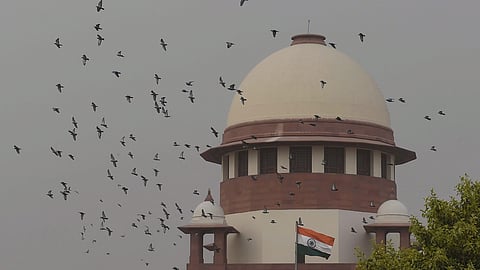
Supreme Court questions Delhi Metro curbs ahead of CJP protest, calls for proportionate restrictions
The Supreme Court on Friday questioned the Centre over sweeping restrictions on Delhi Metro and railway services ahead of the Cockroach Janta Party (CJP)-led protest scheduled for Saturday, October 10, saying security measures cannot leave commuters without access to public transport.
Hearing a petition filed by Communist Party of India (Marxist) general secretary MA Baby challenging the restrictions and train cancellations, the court said authorities could regulate movement to maintain law and order but could not impose a complete shutdown of transport services.
“You can't use a sledgehammer to kill a fly,” the court observed while questioning the scale of the measures announced ahead of the demonstration.
The court stressed that the restrictions must be proportionate to the security threat and directed the Centre to reconsider the number of metro station entrances and exits being closed. It also said road closures should be reviewed and authorities should assess which areas genuinely require restrictions.
Supreme Court flags commuters’ right to public transport
Chief Justice of India Surya Kant expressed concern about the impact of the restrictions on people travelling to Delhi from neighbouring areas, including Gurugram, Greater Noida, East Delhi and South Delhi, for work and other essential purposes.
“We are primarily concerned about the complete closure of these metro station entrances. Our concern is not about any specific protester or individual; rather, it is about the hundreds and thousands of commuters who travel to Delhi from Gurugram, Greater Noida, East Delhi, and South Delhi for their livelihoods,” the Chief Justice told Solicitor General Tushar Mehta.
The Chief Justice said that the court's concern was the hardship faced by ordinary commuters rather than any particular protester or individual. He emphasised that people of all ages, including young people and the elderly, depended on public transport for their daily journeys.
“Young people, elderly all travel. Commuters have a right to basic facilities,” the Chief Justice said, asking the Centre to reduce the number of metro stations affected by the restrictions.
The court drew a distinction between regulating public transport and shutting it down entirely. It said the frequency of metro services could be reduced if necessary, but services should not be brought to a complete halt.
Kapil Sibal questions sweeping restrictions
Senior advocate and Rajya Sabha MP Kapil Sibal, appearing for petitioner MA Baby, argued that the restrictions amounted to shutting down large parts of the national capital despite the proposed demonstration being a peaceful protest.
“All trains are cancelled, Metro stations are closed. You cannot move anywhere. What is happening to my country? This is a peaceful protest,” Sibal told the court.
The petition challenged the closure of metro station entrances and exits and the cancellation of trains arriving at major railway stations in Delhi. The plea argued that the measures would affect ordinary citizens and restrict their ability to travel across the city.
Other senior advocates, including Abhishek Singhvi, Vrinda Grover and Gopal Sankaranarayanan, along with advocate Prashant Bhushan, also urged the court to intervene over the proposed restrictions, according to reports on the hearing.
The bench, comprising Chief Justice Surya Kant and Justices Joymalya Bagchi and V Mohana, also stressed that the right to peaceful protest had to be exercised within the framework of applicable laws. Justice Bagchi observed that holding a demonstration without permission would not be in accordance with the law, while noting that a peaceful protest was not unconstitutional in itself.
Centre promises proportionate measures
Responding to the court's concerns, Solicitor General Tushar Mehta said he would consult the government and ensure that proportionate measures were taken.
“Regarding railways and metro stations, I will go back to the government and proportionate measures will be taken,” Mehta assured the bench.
The Solicitor General also referred to a previous CJP protest in July, citing incidents of violence and concerns over the potential for crowds to move towards sensitive locations. The authorities have maintained that the restrictions were intended to prevent a law-and-order situation during Saturday's demonstration.
The court, however, said security considerations could not justify depriving commuters of essential transport facilities. It directed the authorities to assess which areas required restrictions and which could remain accessible, while specifically asking for road closures to be reconsidered.
The bench indicated that reducing metro train frequency could be an option, but completely stopping services was not acceptable.
Metro and railway restrictions announced ahead of October 10 protest
Earlier on Friday, the Delhi Metro Rail Corporation (DMRC) announced that entry and exit gates at 57 metro stations would be closed from 9pm on October 9 until further notice, following a request from Delhi Police. The restrictions were scheduled to continue through October 10, with interchange facilities remaining available at the affected stations except New Delhi metro station.
The police request cited the possibility of large crowds moving towards sensitive locations during the CJP-led demonstration at Jantar Mantar and other locations in the New Delhi district. The advisory also allowed for metro train frequencies to be reduced depending on the situation.
Rail services were also affected ahead of the protest, with several trains scheduled to arrive at New Delhi and Hazrat Nizamuddin railway stations cancelled.
The CJP demonstration is planned amid opposition demands for action against Chief Election Commissioner Gyanesh Kumar over alleged irregularities in the Special Intensive Revision (SIR) of electoral rolls. The proposed agitation has drawn support from opposition parties and student organisations.
The Supreme Court's intervention sought to balance the authorities' responsibility to maintain public order with commuters' access to essential services and citizens' right to peaceful assembly. The Centre's assurance of proportionate measures came as the court questioned whether such extensive restrictions were necessary ahead of the planned protest.


