.png)
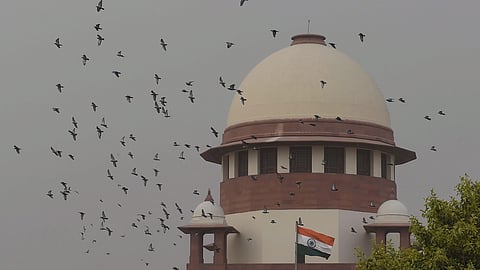
Supreme Court orders state-wise accountability for Yamuna pollution, warns of penalties
The Supreme Court has directed the Central Pollution Control Board (CPCB) to monitor the quality of water in the Yamuna as it enters and exits every state, Union Territory and district along its course, warning that authorities will face penalties if pollution levels worsen within their jurisdiction.
The order, passed by a bench of Justices Manoj Misra and Manmohan, comes amid continuing concerns over the failure of successive clean-up efforts despite substantial public expenditure.
The court said the condition of the river reflected the shortcomings of civic administration in the towns, cities and villages along its banks, as well as the wastewater discharged through 520 drains.
“This Court is of the opinion that everything that is wrong with civic administration in the towns, cities and villages situated along the banks of the river is reflected in the poor health of the river and in the 520 (five hundred twenty) drains that discharge wastewater into the Yamuna. This is why, despite huge sums being spent on cleaning the river, pollution in the Yamuna has only increased,” the bench observed.
It directed the CPCB to monitor water quality at the points where the Yamuna and major drains enter and leave each state, Union Territory and district. If water quality deteriorates on any parameter while passing through a particular jurisdiction, the concerned state, Union Territory or district will be held accountable and penalised.
The CPCB has also been asked to recommend a formula for calculating environmental compensation. States may recover the amount from polluters and officials found negligent following an inquiry.
Treatment plants and pollution sources under scrutiny
The bench stressed that industrial pollution and untreated sewage must be prevented at their source, observing that simply building more sewage treatment plants (STPs) would not be enough to restore the river.
It also flagged inconsistencies in Delhi's Yamuna Action Plan concerning encroachments in Zone 'O'. While the plan claimed that 35 water bodies and wetlands in the zone were free of encroachments, an annexure submitted by the Delhi government itself identified all 35 as encroached.
The court further noted that none of Delhi's 37 existing STPs complied with all the prescribed standards.
Invoking the doctrine of Common But Differentiated Responsibilities, the bench said states sharing the Yamuna must regard it as one continuous ecosystem. Their responsibilities, however, should be determined by their respective contributions to pollution and their capacity to address it.
The court also directed all STPs, Common Effluent Treatment Plants (CETPs) and government-commissioned biogas plants to install tamper-proof smart energy meters within one month.
These facilities will have to upload real-time information about their operations and the quality of their discharge. The CPCB has been tasked with conducting surprise inspections every quarter. Environmental compensation will be recoverable for every day a facility remains non-compliant.
CPCB given unrestricted inspection and monitoring powers
Recognising the extensive monitoring, investigative, technical and regulatory responsibilities assigned to the CPCB, the Supreme Court directed central and state authorities to provide the board with all necessary assistance without delay.
All government ministries, departments, organisations and authorities, at both the central and state levels, must extend administrative, logistical, technical, operational and infrastructure support to the CPCB, its authorised officers and the expert and academic institutions working with it.
Public and private entities, concessionaires, operators and agencies managing wastewater, solid waste and effluent treatment facilities have been directed to provide immediate, unhindered and unconditional access to their premises, installations and records.
The access must be available at all hours to CPCB officials and designated third-party agencies, including the Indian Institutes of Technology (IITs), National Institutes of Technology (NITs) and accredited laboratories. It will enable unannounced inspections, surprise collection of samples, volumetric audits, sensor verification and technical assessments.
The court further ordered all concerned departments, authorities, concessionaires and plant operators to provide complete technical cooperation and unrestricted access to data. They must ensure seamless integration of their facilities with the CPCB's centralised monitoring system within the timelines fixed by the court.
Police and district authorities have also been directed to assist inspection teams whenever required. Commissioners of Police, District Magistrates and Superintendents of Police across the Yamuna basin must promptly provide executive magistrates and armed police personnel when requisitioned by the CPCB.
Senior nodal officers to be appointed within two weeks
The Supreme Court has directed the Chief Secretaries of all Yamuna basin states and Union Territories, along with the Secretaries of the concerned Union ministries, to nominate senior officers to coordinate implementation of its directions.
Each officer must be at least of the rank of Special Secretary and must be appointed within two weeks.
The designated nodal officers will serve as the single point of contact for the CPCB, coordinate between government departments, resolve administrative bottlenecks, ensure timely submission of compliance reports and secure prompt responses to all requisitions made by the pollution control board.
The court also directed that Delhi's Zone 'O' be protected as a green zone. Existing structures in the area must be removed in accordance with the law, while occupants who are legally entitled to rehabilitation must be provided for.
Supreme Court's continuing scrutiny of Yamuna clean-up efforts
The latest directions form part of the Supreme Court's continuing proceedings on the remediation of polluted rivers. The court initiated suo motu proceedings in January 2021 after taking note of the contamination of rivers through sewage discharge, initially focusing on the Yamuna.
In 2026, the bench stepped up its scrutiny of the river's clean-up strategy and sought a comprehensive action plan from a committee headed by the Union Home Secretary, with the participation of the states and Union Territories through which the Yamuna flows.
In September, the court questioned the absence of proposals to remove or relocate encroachments and unauthorised structures on Delhi's riverbed, floodplains and drains. It also sought details of 1,799 unauthorised colonies identified for integrated sewerage systems, noting that around 73% of the work had been completed.
The bench subsequently sought clarification on the treatment of floodplains under the Yamuna Action Plan and Delhi's Master Plan, as well as the proposed measures for addressing encroachments.
The latest order seeks to move beyond plans and expenditure by establishing measurable monitoring mechanisms and fixing responsibility for deterioration in water quality. It places the CPCB at the centre of enforcement and requires every state and district along the river to account for its contribution to the Yamuna's condition.


