.png)
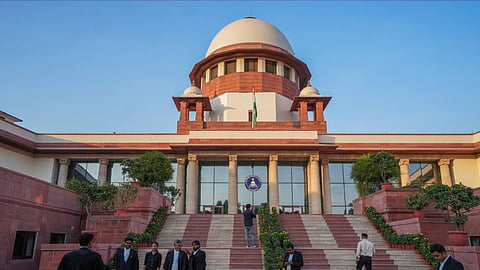
Supreme Court asks states, UTs to consider retirement age of judicial officers to 62 years

The Supreme Court on Tuesday asked all states and Union territories to consider enhancing the age of superannuation of judicial officers in the district judiciary to 62 years.
A bench comprising Chief Justice Surya Kant and Justices Joymalya Bagchi and V Mohana said that enhancing the age of retirement would not create an additional financial burden on states as they are already in service.
Rejecting the submissions against the proposal from a few states, where retirement age is either 58 or 60 years for other public servants, the CJI said that unlike them, judicial officers start their service quite late and hence permitting them to continue up to 62 years would not add to the financial burden.
“Please try to impress upon the chief ministers to fall in line,” the bench told the advocate generals of the states which are reluctant to raise the retirement age of serving judicial officers.
States like Uttar Pradesh and Uttarakhand took the plea of financial constraints in implementing the suggestions on the issue.
Nagaland said that the retirement age for public servants in the state is 58 years and raising it for judicial officers may create problems.
However, states like Madhya Pradesh, Tamil Nadu and Telangana agreed to the proposal of raising the retirement age of judicial officers in district courts.
The bench took note of divergent views expressed by states on the issue and asked them to come out with a positive response. It fixed the plea for hearing on September 17.
Court says experienced judges could reduce costs
Earlier, the bench had said that states cannot cite financial burden to oppose raising the retirement age of judicial officers. It had asked state governments to revisit the issue of enhancing the age of superannuation of judges.
"We impress upon all state governments to revisit the issue of enhancement of the age of retirement of judicial officers, irrespective of the age of superannuation prescribed for other government employees," the bench said.
The top court said retaining experienced judicial officers may impose a lesser financial liability than retiring them and filling the resulting vacancies.
"We have no reason to doubt that the continuation of experienced and seasoned judicial officers would entail a lesser financial liability than what the State would incur upon their retirement.
"The reasons assigned by state governments for declining to enhance the age of retirement are, therefore, untenable. However, we are of the considered opinion that the larger issue should be resolved through consensual measures," the bench said.
States asked to decide within two weeks
In its order, the top court said the issue shall be revisited on an urgent basis and an independent and pragmatic decision shall be taken within two weeks.
"In the event a state government decides to enhance the age of retirement, the benefit of such decision shall also be extended to judicial officers who retire during the intervening period," the bench said.
The top court had earlier asked the states and Union territories to consider raising the age of superannuation of judicial officers from 60 to 61 years.
The bench was hearing a petition seeking uniform enhancement of the retirement age of district judiciary judges from 60 to 62 years.
"All state governments and Union territories (UTs) are directed to take a decision, in consultation with their respective jurisdictional high courts, on this issue. In case they agree, judicial officers in such states shall be permitted to continue in service up to the age of 61 years. Such continuation shall remain subject to the final outcome of these proceedings," the bench ordered.
Retirement age differs across judiciary
While the retirement age of Supreme Court judges is 65, the high court judges superannuate at the age of 62 years.
The issue arises against the backdrop of the top court's 2002 judgment declining to accept the recommendation of the Justice K Jagannatha Shetty Commission, which had proposed raising the retirement age of district judges to 62 years.
Since then, some states, including Telangana and Madhya Pradesh, have moved towards increasing the retirement age.
On November 20, last year, a bench headed by the then CJI B R Gavai, since retired, had raised the retirement age of judicial officers of Madhya Pradesh from 60 to 61 years.
The bench, in its interim order, had referred to a similar decision taken by the Telangana High Court.
It asked why judicial officers should be denied the relief when the state government was willing to do so.

