.png)
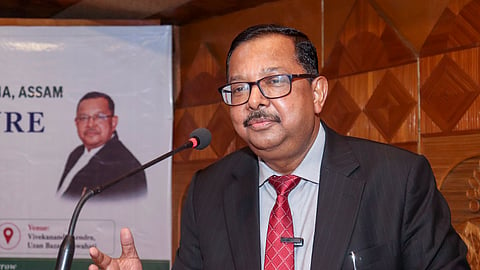
‘No whataboutery can justify it’: SC judge Ujjal Bhuyan warns against mass deletion of voters
Supreme Court judge Justice Ujjal Bhuyan on Sunday delivered a strong constitutional warning against mass disenfranchisement, saying no amount of “whataboutery” could justify a process that deprived millions of Indian citizens of their voting rights and effectively reduced them to “second-class citizens”.
Speaking at the valedictory address of the 19th NALSAR-Justice B R Sawhney Memorial Moot Court Competition in Hyderabad, Justice Bhuyan said any process resulting in wholesale disenfranchisement would violate Articles 14 and 326 of the Constitution. His remarks came amid continuing legal and political controversy over the Election Commission’s Special Intensive Revision (SIR) of electoral rolls.
‘Intrinsically arbitrary’
Justice Bhuyan said the Constitution did not envisage two categories of Indians — citizens possessing voting rights and those deprived of them.
“If any process results in disenfranchising millions and millions of Indian citizens, making them second-class citizens in their own country in the sense of being citizens without voting rights, such a process is intrinsically arbitrary,” he said.
“No amount of whataboutery can justify it,” the judge said, adding that such an exercise would strike at the heart of the Constitution and amount to a negation of India’s constitutional order.
Justice Bhuyan said Article 326, which provides for elections to the Lok Sabha and state Assemblies on the basis of adult suffrage subject to recognised disqualifications, could not be tinkered with.
“No authority can do it; no court can condone it. No one is above the Constitution,” he said.
Notice before deletion
The judge also addressed the procedure for removing names from electoral rolls, stressing the safeguards that must precede such action.
Except in the case of a deceased voter, Justice Bhuyan said, the name of a person already enrolled could not be deleted without notice and an opportunity for a hearing.
He referred to the Supreme Court’s 1995 judgment in Lal Babu Hussain vs Electoral Registration Officer, which dealt with safeguards surrounding deletion from electoral rolls.
Justice Bhuyan said the right to vote or to remain included on the electoral roll could not simply be separated from the identity of an Indian citizen. Doing so, he said, would be “like taking out the soul from the body”.
Right central to democracy
Justice Bhuyan acknowledged that the Supreme Court has not treated voting as a fundamental right, but said it has recognised the franchise as a constitutional right.
In his view, the right of an Indian citizen to cast a vote was central to the basic structure doctrine because free and fair elections themselves form part of the Constitution’s basic structure.
He traced universal adult franchise to India’s freedom struggle and the Constituent Assembly’s decision to grant every adult citizen an equal vote irrespective of literacy, wealth, property or social position.
A billionaire and a rickshaw puller, he pointed out, possess votes of equal value. The principle reflected the Constitution’s commitment to political equality despite deep social and economic inequalities.
SIR under scrutiny
The remarks assume significance against the backdrop of challenges to the Election Commission’s ongoing voter-roll revision process. Petitioners have raised concerns over large-scale exclusions and notices issued to electors, while the Election Commission has maintained that the revision is intended to remove duplicate, deceased and otherwise ineligible entries and protect the integrity of electoral rolls.
The poll panel has also said eligible voters inadvertently left out should be enrolled and has directed officials to identify and register such electors. The Supreme Court has separately been examining challenges concerning aspects of the revision exercise.
Justice Bhuyan did not frame his address as an adjudication of the pending challenges. His remarks instead set out his constitutional view on universal adult franchise and the safeguards that must accompany any process capable of removing citizens from electoral rolls.
Political reactions follow
Congress leader Jairam Ramesh cited the judge’s remarks to renew his party’s criticism of Chief Election Commissioner Gyanesh Kumar, alleging that the comments demonstrated constitutional violations by the poll body. Trinamool Congress MP Mahua Moitra also welcomed Justice Bhuyan’s intervention. These were political reactions to the speech, not findings made by the Supreme Court against the CEC or the Election Commission.
The Election Commission has rejected allegations that the voter-roll revision is designed to favour the ruling BJP. The BJP has similarly denied Opposition claims that the exercise is intended to disenfranchise eligible voters.
Justice Bhuyan, meanwhile, placed the issue in the larger constitutional history of the franchise, arguing that voting was inseparable from the freedom secured through India’s struggle against colonial rule. He ended by underlining the value of citizenship itself in a democracy, asking what a citizen would be worth without the right to vote.


