.png)
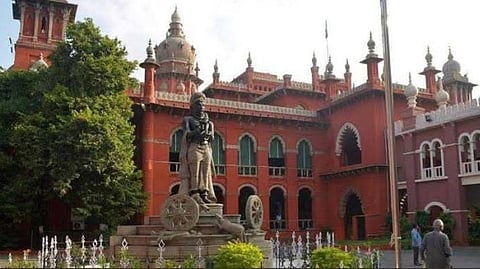
Madras High Court upholds Speaker's acceptance of AIADMK MLAs' resignations, sets 2-month deadline
The Madras High Court on Tuesday, October 13, upheld the Tamil Nadu Legislative Assembly Speaker's decision to accept the resignations of MLAs who quit the All India Anna Dravida Munnetra Kazhagam (AIADMK) shortly after the state elections and subsequently joined actor Vijay's Tamilaga Vettri Kazhagam (TVK).
A bench comprising Chief Justice SA Dharmadhikari and Justice G Arul Murugan held that the resignations were genuine and that the Speaker was not required to conduct a detailed inquiry into the circumstances or motives behind them. However, the court clarified that accepting the resignations would not prevent disqualification proceedings against the legislators from continuing.
The bench directed the Speaker to complete the pending disqualification proceedings within two months. The judgment is reported as 2026 LiveLaw (Mad) 498.
Court distinguishes resignation from disqualification proceedings
The dispute arose after the MLAs resigned from the Tamil Nadu Legislative Assembly on May 25, 2026, and joined TVK on the same day. Their resignations were accepted by the Speaker that day, followed by publication of the decision in the Gazette.
The petitioners challenged the manner in which the resignations had been accepted, arguing that the Speaker should have conducted a more detailed inquiry under Article 190 of the Constitution to establish that the decisions were voluntary.
The court, however, held that the Speaker's responsibility was to verify the genuineness of a resignation rather than investigate the motives behind it. It also made clear that acceptance of a resignation does not extinguish the consequences of conduct that may attract disqualification under the Tenth Schedule of the Constitution.
The Legislative Assembly Secretary had argued that the challenge was based on an incorrect legal premise, as resignation from the Assembly does not automatically defeat or render infructuous disqualification proceedings relating to a member's conduct before resignation.
How the dispute began after the Tamil Nadu election
The results of the Tamil Nadu Assembly elections were declared on May 4, 2026, with TVK emerging as the party with the highest number of votes. However, the party secured 108 seats, falling short of the 118 required for a majority in the 234-member Assembly.
TVK subsequently sought support from other political parties and formed the government. A confidence motion was held on the Assembly floor on May 13, during which the government secured 144 votes in its favour.
According to the party's account, TVK had issued a whip to its members on May 11, directing them to oppose the confidence motion. However, 25 MLAs voted in favour of the TVK government on May 13, contrary to the party's stated position.
Proceedings were initiated against the legislators on May 14 under the Tenth Schedule of the Constitution, which contains provisions relating to disqualification on grounds of defection.
The Speaker was informed of alleged cross-voting and possible horse-trading. Proceedings against some of the MLAs were subsequently dropped after they apologised for their actions.
The legislators later submitted their resignations on May 25. On the same day, the Speaker accepted the resignations, a Gazette notification was issued and the MLAs joined TVK.
Petitioners allege lack of proper inquiry
The petitioners argued that Article 190 of the Constitution required the Speaker to conduct an inquiry to ensure that the resignations were voluntary and genuine.
They contended that the speed with which the resignations were accepted raised questions about the procedure followed. According to their submissions, the resignation letters were handed over at around 2.30 pm on May 25, accepted that day and followed by a Gazette notification. The MLAs also joined TVK on the same day, which the petitioners cited as an indication of possible horse-trading.
They argued that a proper inquiry should have included issuing notice to the AIADMK, allowing the party an opportunity to oppose the resignations. The petitioners described the procedure as a sham compliance with the requirements of Article 190.
Speaker says resignations were voluntary
The Speaker maintained that the resignations had been accepted only after he was satisfied that the legislators were acting voluntarily and without coercion or undue influence.
According to his submission, he personally questioned each MLA when the resignation letters were presented to him to determine whether the decision to resign had been made freely.
Senior Advocate CS Vaidyanathan, appearing in support of the Speaker's decision, argued that Article 190(3)(b) did not require the Speaker to investigate the motive behind a member's resignation. He submitted that the constitutional requirement was to establish the genuineness of the resignation, which, he argued, had been done in this case.
Vaidyanathan also pointed out that there was no allegation that the resignation letters had been written by someone other than the legislators themselves. He maintained that the Speaker's decision was consistent with the Constitution and involved no procedural impropriety.
The Legislative Assembly Secretary separately argued that resignation could not be used to extinguish or defeat pending disqualification proceedings under the Tenth Schedule.
Resigning before joining another party was an exercise of choice, MLAs argue
Senior Advocate Menaka Guruswamy, appearing for the MLAs who resigned, argued that every vacancy in the Assembly should not automatically be viewed as the result of corruption or malpractice.
She submitted that the legislators had chosen to resign from their Assembly seats before joining another political party. Their decision, she argued, could not therefore be presumed to have been motivated by malice.
Guruswamy also described the resignations as an exercise of political dissent and democratic choice, arguing that legislators had the right to resign from their party and relinquish their seats.
The court's ruling upholds the Speaker's acceptance of the resignations while preserving the separate question of whether the legislators' earlier conduct warrants disqualification.
Lawyers who appeared before the court
The petitioners were represented by Senior Advocate V. Giri, appearing for S. Inbadurai, and S.R. Rajagopalan.
The respondents were represented by Senior Advocates CS Vaidyanathan and Menaka Guruswamy, along with Advocate General Vijay Narayan. The legal team also included Government Pleader Mohammed Fayaz Ali, Standing Counsel Niranjan Rajagopalan, Dixita Gohil, Pranjal Agarwal and Yash S Vijay.


