.png)
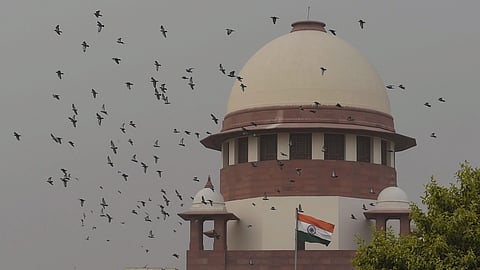
'Future scrutiny' remains open: Supreme Court upholds hanging as execution method
The Supreme Court on Tuesday declined to direct a change in the method used to execute death sentences, upholding the existing legal position that hanging remains constitutionally valid.
A bench of Justices Vikram Nath and Sandeep Mehta said there was no ground to revisit the 1983 Constitution Bench ruling in Deena @ Deena Dayal vs Union of India, which had upheld hanging as a valid mode of execution.
At the same time, the court made it clear that the issue could be examined again if scientific or technological developments offer new possibilities.
“The dismissal does not foreclose any future scrutiny based on scientific knowledge and subsequent developments,” the bench said while pronouncing its operative order.
Court leaves door open for alternatives
The bench said its ruling would not stop the Union government from reviewing the existing method of execution. It noted that future scientific, neurological or other developments could be considered if they offered a way to reduce unnecessary pain while maintaining the dignity of condemned prisoners.
Also Read | Delhi HC gives Kejriwal, Sisodia four weeks to respond to CBI plea
The case arose from a petition filed by senior advocate Rishi Malhotra, who appeared in person and challenged the constitutional validity of execution by hanging.
The petition questioned Section 354(5) of the Code of Criminal Procedure, a provision now reflected in Section 393(5) of the Bharatiya Nagarik Suraksha Sanhita, 2023. The law provides that a death sentence is to be carried out by hanging.
Malhotra argued that hanging was an outdated and painful form of execution and violated the right to life with dignity under Article 21. He had sought either the striking down or reading down of the provision and proposed allowing a more humane method, including giving condemned prisoners a choice.
Government had examined other methods
The matter has been pending before the Supreme Court since 2017. During the proceedings, the Union government told the court that alternative methods of execution were being examined by a committee constituted for the purpose.
Also Read | 'If airlines are not complying, ground them': Supreme Court pulls up Centre on aviation rules
At an earlier hearing in January, the bench had questioned whether deciding on a less painful method was a matter for the judiciary or the executive, given that hanging is prescribed by law.
“The question is who should decide all this,” the bench had observed.
The Union government had maintained that hanging remained the “safest and quickest” method of execution. It also opposed lethal injection, pointing to botched executions in the United States and concerns about involving medical professionals in carrying out executions.


