.png)
Did Delhi Police illegally track protesters? Supreme Court to hear biometric surveillance plea

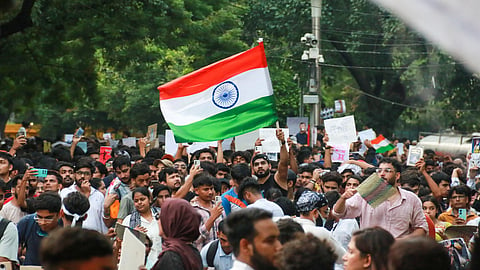
The Supreme Court on Thursday agreed to hear a plea filed by a Rajya Sabha lawmaker challenging the alleged deployment of facial recognition technology and other biometric surveillance measures by Delhi Police during the recent student protest at Jantar Mantar here.
Supreme Court tags plea with related cases
A bench of Chief Justice Surya Kant and Justices Joymalya Bagchi and V Mohana directed that the matter be tagged with earlier petitions concerning the issue.
Senior advocate Menaka Guruswamy, appearing for Rajya Sabha MP AA Rahim, said two issues were of concern: facial recognition of protesters by Delhi Police and the storage of data by private companies.
"One maps your face and one is a vehicle. So spectacles are used and a vehicle is also used. And that data is all taken without permission. These private entities host the data. In violation of the rules…," she submitted.
The bench said it would hear the plea along with the other related matters.
Plea alleges 'legal vacuum' in biometric surveillance
Rahim, a Rajya Sabha member from Kerala representing the Communist Party of India (Marxist), has sought a declaration that indiscriminate biometric surveillance at peaceful public assemblies is unconstitutional.
The plea, filed through advocate Subhash Chandran K R, also seeks restrictions on such surveillance until Parliament enacts a law specifically authorising and regulating its use.
According to the petition, Delhi Police carried out biometric surveillance in a "complete legal vacuum". It argues that neither the Delhi Police Standing Orders governing protests nor the Criminal Procedure (Identification) Act, 2022, authorises biometric surveillance of people taking part in civilian assemblies.
Protesters, journalists allegedly monitored
The plea alleges that police used automated systems to extract and match protesters' biometric identifiers and linked the data with permanent national criminal databases.
It further claims that protesters, journalists and other members of the public were subjected to continuous surveillance through photographs and video captured using CCTV cameras, drones and a mobile command-and-control vehicle.
The petition also refers to an RTI response from Delhi Police, which it says confirms that no privacy impact assessment was conducted before facial recognition technology was deployed.
Plea invokes right to privacy
The petitioner has relied on the Supreme Court's landmark judgment in KS Puttaswamy vs Union of India, arguing that the alleged surveillance fails the constitutional requirements of legality, legitimate state purpose and proportionality.
The plea seeks disclosure of the technologies, databases and vendor arrangements involved in the alleged surveillance. It also seeks a mechanism through which affected individuals can access their data and request its deletion.
It further asks private companies holding biometric information to preserve the data for the proceedings, stop using it and permanently delete it thereafter.

