.png)
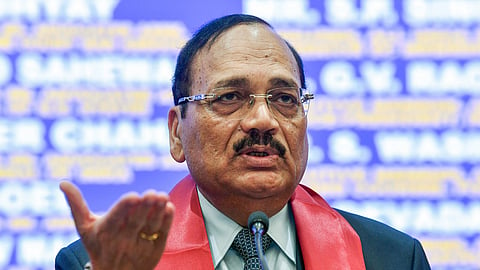
CJI clarifies no writ filed on Delhi student protest, slams ‘irresponsible media reports'

Chief Justice of India Surya Kant on Friday clarified that the Supreme Court had not received any writ petition seeking judicial intervention into the alleged police excesses during the July 20 student protest in Delhi, while expressing strong displeasure over media reports claiming that the court had refused to hear such a case.
The clarification came during the hearing of an unrelated matter when the issue of recent reportage concerning the July 20 crackdown was raised before a bench comprising the Chief Justice and Justices Joymalya Bagchi and V Mohana.
The CJI said he had personally verified the court records after reports suggested that the Supreme Court had declined to list a petition challenging the police action. According to him, no such petition had been formally filed before the court.
"There was nothing on record. I checked with the Registry and not a single page had been filed," the Chief Justice observed, adding that what had reached the court was merely a representation and not a petition that could be treated as a writ case.
He questioned how a representation could be considered equivalent to a properly instituted petition and criticised what he described as irresponsible reporting suggesting that the court had refused to hear the matter.
Expressing concern over the coverage, the Chief Justice remarked that inaccurate reports had created the impression that the Supreme Court had rejected a petition that, in fact, had never been filed.
The controversy traces back to Wednesday, when advocate Narendra Mishra orally requested the Supreme Court to take suo motu cognisance of the alleged use of excessive force by police during the July 20 Parliament march organised by the Cockroach Janata Party (CJP). Mishra referred to a letter addressed to the Chief Justice and urged the court to examine videos purportedly showing police personnel assaulting protesters.
The bench declined to entertain the oral request, observing that it was not inclined to initiate proceedings on the basis of videos alone. It also refused to grant an urgent hearing.
While the Supreme Court did not proceed with the oral mention, the Delhi High Court on the same day directed authorities to preserve CCTV footage, videography and other material related to the police action. The High Court also sought responses from the Centre and Delhi Police on petitions challenging the crackdown. The matter is scheduled to be taken up on September 11.
The police action followed the July 20 march towards Parliament, called by the CJP after weeks of protests over alleged examination paper leaks and demands for reforms in the recruitment and examination system. As demonstrators attempted to move past barricades in central Delhi, police used tear gas and conducted baton charges to disperse the crowd.
Videos from the protest circulated widely on social media, showing clashes between protesters and security personnel. While protesters alleged excessive use of force, Delhi Police maintained that action became necessary after sections of the crowd turned violent and resorted to stone-pelting.
The Chief Justice's remarks also came on a day when activist Sonam Wangchuk ended his 26-day hunger strike after receiving assurances from the Centre. Although Wangchuk called off his fast, leaders of the CJP said their agitation would continue until their broader demands, including the resignation of Union Education Minister Dharmendra Pradhan and systemic examination reforms, are addressed.

