.png)
'Can't use hammer to kill fly': SC on blanket closure of Metro stations, cancellation of trains
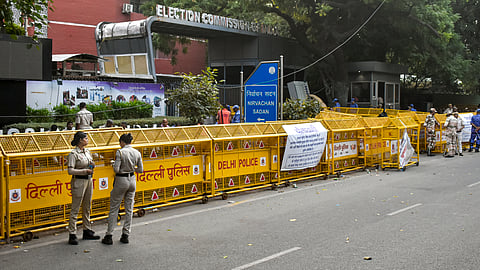
Expressing serious concern over the proposed closure of 57 Metro stations and cancellation of trains arriving at New Delhi and Hazrat Nizamuddin railway stations ahead of Saturday's protest in the national capital, the Supreme Court on Friday cautioned the Centre against imposing sweeping restrictions and observed that the authorities "cannot use a hammer to kill a fly".
A bench comprising Chief Justice Surya Kant and Justices Joymalya Bagchi and V Mohana emphasised that security measures must adhere to the principle of proportionality and directed that there could be no complete prohibition on essential transport services. The court was hearing a petition challenging the suspension of railway and Metro services ahead of protests announced by the Cockroach Janta Party (CJP) and opposition parties demanding the resignation of Chief Election Commissioner Gyanesh Kumar.
Court stresses proportionality
"One very important principle that we follow for every citizen is the principle of proportionality… You have to prevent certain things. Take measures only to the extent necessary to prevent them. But that does not mean you use a hammer to kill a fly. That principle must be kept in mind," CJI Kant told Solicitor General Tushar Mehta, appearing for the Centre.
Mehta assured the bench that he understood its concerns and would discuss the matter with the authorities concerned. However, he clarified that the Chief Justice's reference to using a hammer was merely an illustration and should not be reported as an accusation that the government was employing such measures.
The Chief Justice acknowledged the responsibility of law enforcement agencies to maintain public order but stressed that their duty extended beyond protecting government property.
"Exercise caution in abundance. There is nothing wrong with that. You are responsible for maintaining law and order. But that responsibility is not merely about protecting the State property; it is about protecting people. That is your sovereign duty," he observed.
The bench pointed out that public transport was used by women, children, senior citizens, elderly persons and patients, whose mobility and safety could not be disregarded while enforcing security arrangements.
"There is absolutely no difficulty with taking appropriate measures. But make sure that everything is not brought to a halt. There cannot be complete prohibition," the court said.
Commuters must be protected
At the outset, the bench expressed serious reservations about the orders directing the closure of Metro stations from 9 pm on Friday until further orders, along with the cancellation of mainline and express trains.
"Our concern is not with respect to any protester or any individual. Our concern is about the hundreds and thousands of commuters who come from Gurugram, Greater Noida, East Delhi and South Delhi to Delhi for their livelihood," the bench observed.
It noted that students, employees and senior citizens depended on public transport for their daily activities and that their interests must be protected even when authorities anticipated disturbances.
"We are speaking on behalf of the common citizens of this city. The law enforcement authorities are certainly entitled to take regulatory measures. There is no doubt about that. If you want to restrict unruly movement, you can do so. But that does not mean you can bring everything to a halt and leave people without any transport facility," the court said.
Justice Bagchi observed that regulating train frequency or restricting access to particular Metro stations could constitute reasonable preventive measures, but completely suspending services indefinitely would be excessive.
"You can regulate the frequency of trains, but don't stop it altogether," he told Mehta.
The solicitor general submitted that extraordinary circumstances could sometimes justify a complete suspension of services. He argued that law enforcement agencies could not always anticipate how a situation might develop and therefore required a degree of operational flexibility.
Justice Bagchi acknowledged that such flexibility might be necessary but questioned whether an advance order shutting Metro stations from Friday night until further notice could legitimately be regarded as a proportionate regulatory measure.
Justice Mohana also expressed concern after lawyers submitted that extensive barricading had restricted vehicular movement across the capital.
"If tomorrow anything untoward happens, who will be responsible? Some measures are required but in a proportionate manner," she observed.
Centre defends security arrangements
Mehta disputed suggestions that the entire national capital had been effectively shut down, maintaining that the authorities had adopted proportionate preventive measures based on security assessments.
He referred to violence that allegedly followed the July 20 attempt by CJP protesters to march towards Parliament, arguing that the previous incident justified heightened precautions ahead of Saturday's demonstration.
The solicitor general also informed the court that internet restrictions were confined to certain sensitive areas around the President's House.
"I have taken instruction and I am being told that the internet shutdown was only effective in certain sensitive pockets in the vicinity of the President's House in a radius of 4 kilometres and that too will be reviewed based on the security inputs," he submitted.
The bench clarified that it was restricting its consideration to the disruption of transport services because none of the political parties or organisations responsible for the October 10 protest was represented before it.
When advocate Vrinda Grover raised allegations that police personnel had visited mosques and hotels and advised people against participating in the demonstrations, the court declined to examine the issue solely on the basis of statements made during the hearing. It noted that none of the persons directly affected by the alleged actions had approached the court.
Alternative protest venue suggested
During the proceedings, the bench also raised the possibility of identifying a designated location for peaceful demonstrations as an alternative to Jantar Mantar.
The court observed that a suitable venue equipped with essential amenities could facilitate lawful protests while reducing disruption to commuters and other residents of the national capital.
"During the course of hearing, it was also suggested, and senior counsel/ counsel for parties are ad idem that it's high time that some suitable place where all basic amenities can be provided for peaceful and lawful protestors needs to be identified and designated. Let the competent authority consider the suggestion and take an appropriate decision," the court ordered.
The observations underscored the need to balance public order considerations with the rights and everyday requirements of citizens, particularly those dependent on public transport. While recognising the government's authority to impose preventive restrictions, the bench made clear that such measures must remain proportionate and should not result in a blanket suspension of essential services.


