.png)
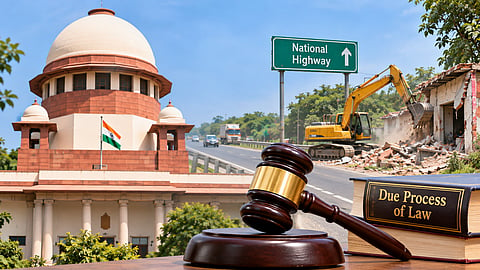
Can highway encroachment orders be used to demolish disputed homes? Supreme Court clarifies
The Supreme Court on Wednesday (November 18) clarified that its earlier directions to remove encroachments along National Highways cannot be treated as blanket permission to demolish disputed structures without following the procedure established by law. The court allowed affected property owners to approach the jurisdictional High Courts and directed authorities to refrain from taking coercive action against the disputed properties until the proceedings are decided.
A bench of Justice Vikram Nath and Justice Aparesh Kumar Singh passed the order while hearing applications challenging demolition notices and action initiated by the National Highways Authority of India (NHAI) and other authorities over alleged encroachments within the Right of Way (ROW) of National Highways.
The bench made it clear that its April 13, 2026, directions for removing unauthorised encroachments did not determine whether individual properties actually fell within the highway's ROW.
“The question whether a particular structure constitutes an unauthorised encroachment was neither examined nor adjudicated upon by this Court,” the court observed.
Authorities must follow statutory procedure
The applications arose from the Supreme Court's suo motu proceedings on road safety and the removal of encroachments following accidents in Phalodi, Rajasthan, and other locations.
Addressing the competing claims of property owners and highway authorities, the court said neither an ownership claim nor an official assertion of encroachment could automatically settle the dispute.
"We are conscious that a mere assertion of ownership or lawful occupation cannot, by itself, prevent the authorities from exercising their statutory powers to remove unauthorised encroachments. Equally, the mere assertion by the authorities that a particular structure falls within the Right of Way cannot be treated as a substitute for the determination required under law, where the very basis of such assertion is disputed.
The competing claims must be examined in accordance with the applicable statutory framework, and the persons affected must be afforded such opportunity of hearing and adjudication as the law requires," the court observed.
Referring to Section 26 of the Control of National Highways (Land and Traffic) Act, 2002, the bench said authorities must ordinarily follow the prescribed procedure, including issuing notices and allowing affected persons to submit their representations. It also cited its ruling in Gyan Prakash v. Union of India to reiterate that statutory safeguards and principles of natural justice cannot be bypassed.
“The directions issued by this Court cannot be invoked as an independent justification for dispensing with the requirements of the statute,” the court observed.
High Courts to examine property disputes
The court said disputes involving land ownership, highway demarcation, acquisition records and compensation claims may require examination of revenue documents and survey reports.
It directed that existing interim protection would continue until the High Courts decide the matters. In cases where no such protection had been granted, authorities were restrained from demolishing or removing the disputed structures in the meantime.
However, the protection is limited to the properties covered by the applications and does not permit fresh construction or encroachment.
“It is made clear that the interim protection shall remain confined to the structures forming the subject matter of these applications and shall not create any equity in favour of the applicants or authorise any fresh construction or encroachment,” the court stated.


