.png)
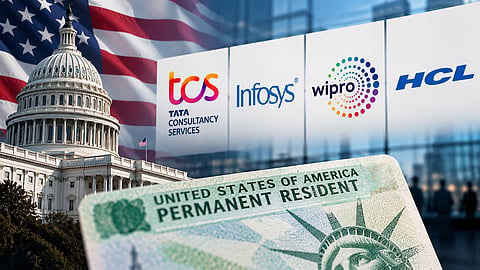
US suspends TCS, Infosys, Wipro, HCL from green card programme amid fraud probe
The Donald Trump administration on Thursday announced the suspension of eight major technology and IT services companies, including Tata Consultancy Services, Infosys, Wipro, HCL Technologies, Cognizant and Capgemini, from a crucial employment-based green card programme, citing alleged abuse of foreign-worker hiring rules and ongoing federal investigations.
US Vice President JD Vance and Labor Secretary Keith Sonderling announced the action at a Washington press conference, saying the government would stop accepting new applications and processing pending cases under the Permanent Labor Certification programme, commonly known as PERM, for the affected companies. American technology giants Microsoft and Adobe were also included in the suspension, making the decision one of the administration's most consequential interventions in employment-based immigration.
Eight companies targeted
Sonderling identified Cognizant, Infosys, Tata, Wipro, HCL and Capgemini among the major outsourcing companies being suspended from the programme. He also announced action against Microsoft and Adobe, referring to multiple active federal investigations.
The decision affects a significant segment of the technology industry's employment-based immigration system, particularly companies that recruit international professionals for specialised technology roles in the United States.
The Labor Department said it would neither accept new permanent labour certification applications involving the named companies nor continue processing their pending applications during the suspension.
The announcement did not establish that all eight companies had committed fraud. Federal officials cited allegations and investigations, while the scope and duration of the restrictions remain important questions for affected employers and workers.
Vance targets foreign hiring
Vance accused major corporations of using immigration programmes to replace American employees with lower-cost foreign workers, arguing that the system had moved away from its original purpose of addressing genuine shortages of specialised skills.
He singled out Microsoft, alleging that the company had laid off American workers while continuing to obtain approvals for foreign employees. He said the administration wanted technology companies to prioritise qualified American workers rather than rely on immigration programmes to reduce labour costs.
Sonderling also cited the cumulative use of foreign-worker programmes by the companies under scrutiny, claiming that the scale of recruitment had affected employment opportunities for American workers.
These assertions represent the administration's stated justification for the action. The allegations against the individual companies remain subject to investigation and any applicable legal proceedings.
What is the PERM programme?
The Permanent Labor Certification programme is an important step in the process through which US employers sponsor foreign nationals for employment-based permanent residency.
Before sponsoring a foreign employee under most employment-based green card categories, a company must demonstrate that there are no qualified, willing and available American workers for the position and that employing the foreign national will not adversely affect wages or working conditions.
The Department of Labor reviews this certification before the employer can proceed with the relevant immigration petition before US Citizenship and Immigration Services.
The suspension announced on Thursday affects this labour certification stage. It does not automatically revoke green cards already issued or cancel the legal status of employees currently working on valid H-1B visas.
Indian professionals face uncertainty
The decision could have substantial implications for Indian technology professionals employed by the affected companies, particularly those seeking to transition from temporary work visas to permanent residency.
Indian IT companies have long been major users of the H-1B programme, which allows American employers to recruit foreign workers in specialised occupations. Many employees subsequently pursue employment-based green cards through company sponsorship.
The suspension means the named employers cannot currently move forward with new or pending PERM labour certification applications. Employees whose permanent residency plans depend on those applications could consequently face delays.
The effect on individual workers will depend on the stage of their immigration applications, their existing visa status and any further guidance issued by US authorities.
No blanket H-1B ban
The distinction between the H-1B programme and PERM is particularly significant.
H-1B visas authorise temporary employment in qualifying specialised occupations, while PERM is generally part of the process for obtaining permanent residency through an employer.
Although the Trump administration has linked its latest action to alleged misuse of the H-1B system, Thursday's announcement specifically suspends the named companies from the PERM programme.
Existing H-1B employees are therefore not automatically required to leave the United States because of the announcement. Nor does the measure establish a general prohibition on Indian nationals applying for green cards through other eligible employers.
Wider immigration crackdown
The action follows a series of measures by the Trump administration aimed at tightening oversight of foreign-worker programmes.
The government previously launched Project Firewall, an enforcement initiative targeting alleged abuses of H-1B hiring rules. It has also introduced additional restrictions and costs affecting certain foreign-worker recruitment arrangements.
The administration argues that such measures are necessary to protect domestic employment and prevent companies from using immigration programmes to suppress wages.
The latest announcement extends that scrutiny to some of the world's largest technology employers, including companies with substantial operations and workforces in India.
Universities also under investigation
Alongside the corporate suspensions, Vance announced investigations into nine American universities over alleged misuse of the J-1 exchange-visitor visa programme.
Institutions identified for scrutiny include Harvard, Yale, Stanford and the Massachusetts Institute of Technology. Federal officials alleged that exchange-visitor arrangements could be used in ways that undermine American wages or involve improper employment practices.
Labor Department Inspector General Anthony D'Esposito said subpoenas had already been issued as part of the investigations.
The university investigations are separate from the PERM suspensions affecting technology companies.
Companies yet to respond
There was no immediate substantive public response from most of the affected technology companies to the allegations announced on Thursday. Tata Consultancy Services declined to comment when approached by Reuters, while several other companies did not immediately respond.
The government has not established a uniform timeline for lifting the suspensions, leaving uncertainty over how long the restrictions may remain in place.
For Indian IT companies, the announcement presents a new regulatory challenge in one of their most important markets. For employees pursuing permanent residency, the more immediate concern is the interruption of employer-sponsored labour certification applications.
The final impact will depend on the duration of the suspension, the outcome of federal investigations and whether the companies are subsequently permitted to resume processing applications.
The immediate consequence is clear: eight major technology employers have been excluded from a critical stage of the US employment-based green card process, even as their existing foreign employees retain whatever immigration status they independently hold.


