.png)
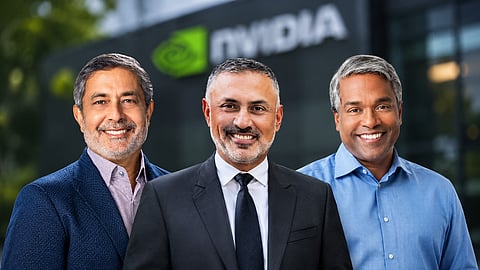
Three Indian-origin executives emerge as contenders for Nvidia CEO post after Huang's exit
Three Indian-origin technology executives have emerged among the potential candidates to replace Jensen Huang as chief executive officer of Nvidia, as the American chipmaker searches for a permanent leader following its co-founder's resignation.
Sanjay Mehrotra, CEO of Micron Technology, Nikesh Arora, CEO of Palo Alto Networks, and Thomas Kurian, CEO of Google Cloud, are among the names being discussed for the position, according to media reports.
Nvidia has appointed its chief financial officer, Colette Kress, as interim CEO while the company's board considers candidates from within and outside the organisation.
Huang stepped down after 33 years at the company amid scrutiny over reports of multiple extramarital affairs, including an alleged relationship with a woman suspected by US authorities of spying for China.
The leadership transition comes at a crucial time for Nvidia, which has become one of the world's most valuable technology companies through its dominance in artificial intelligence chips.
𝗦𝗮𝗻𝗷𝗮𝘆 𝗠𝗲𝗵𝗿𝗼𝘁𝗿𝗮
Mehrotra has served as CEO of Micron Technology since 2017 and brings more than four decades of experience in the semiconductor industry.
He co-founded flash-memory manufacturer SanDisk in 1988 and served as its CEO from 2011 until the company's sale in 2016.
Under his leadership, Micron has expanded its presence in high-bandwidth memory chips, which are essential components of advanced AI computing systems.
Micron also maintains business ties with Nvidia, making Mehrotra's experience in semiconductor manufacturing and supply chains relevant to the company's operations.
𝗡𝗶𝗸𝗲𝘀𝗵 𝗔𝗿𝗼𝗿𝗮
Arora has been leading cybersecurity company Palo Alto Networks since 2018, overseeing its expansion into artificial intelligence-driven security solutions.
Before joining Palo Alto Networks, he served as president and chief operating officer of SoftBank Group.
He also spent approximately a decade at Google, holding senior leadership positions and gaining experience in managing large technology businesses.
His background in enterprise technology, cybersecurity and corporate management has placed him among the executives mentioned as possible external candidates.
𝗧𝗵𝗼𝗺𝗮𝘀 𝗞𝘂𝗿𝗶𝗮𝗻
Kurian, the CEO of Google Cloud, is another Indian-origin executive whose name has surfaced in discussions about Nvidia's next leader.
He oversees Google's cloud infrastructure, enterprise software and artificial intelligence services.
His experience is particularly relevant because cloud computing companies are among the largest customers of Nvidia's advanced processors.
Kurian's leadership of a major cloud services business has given him extensive exposure to the infrastructure requirements of AI development and deployment.
𝗜𝗻𝘁𝗲𝗿𝗻𝗮𝗹 𝗰𝗮𝗻𝗱𝗶𝗱𝗮𝘁𝗲𝘀 𝗮𝗹𝘀𝗼 𝗶𝗻 𝗳𝗼𝗰𝘂𝘀
Apart from the three Indian-origin executives, Nvidia's interim CEO Colette Kress and senior engineering executive Ian Buck are among the prominent internal names being discussed.
Kress has served as Nvidia's CFO since 2013 and is familiar with the company's financial operations, investor relationships and business strategy.
Buck, who joined Nvidia in 2004, played an important role in developing its CUDA computing platform, a technology that helped establish the company's position in AI computing.
Other executives mentioned in succession discussions include Arm CEO Rene Haas, AMD CEO Lisa Su, former Intel CEO Pat Gelsinger, Marvell Technology CEO Matt Murphy, Apple's hardware chief Johny Srouji and former Apple CEO Tim Cook.
However, the names being discussed do not constitute an officially announced shortlist, and Nvidia has not publicly confirmed a final selection.
𝗔 𝗰𝗿𝘂𝗰𝗶𝗮𝗹 𝗹𝗲𝗮𝗱𝗲𝗿𝘀𝗵𝗶𝗽 𝘁𝗿𝗮𝗻𝘀𝗶𝘁𝗶𝗼𝗻
Huang co-founded Nvidia in 1993 and oversaw its transformation from a graphics processor manufacturer into a leading supplier of chips used in artificial intelligence systems.
His departure has created uncertainty over the company's future leadership, with investors closely watching how Nvidia will maintain its technological position and relationships with major customers.
The next chief executive will inherit a business operating at the centre of the global AI industry, with responsibilities extending from semiconductor innovation and supply chains to regulatory scrutiny and geopolitical challenges.
For now, Kress will continue overseeing the company as interim CEO while Nvidia's board evaluates its options for a permanent successor.


