.png)
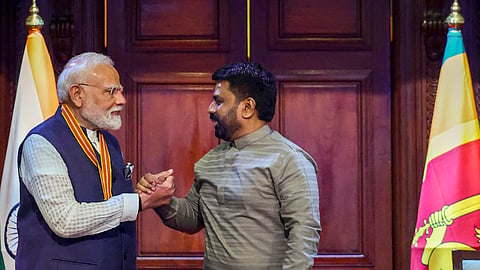
'Sri Lanka will not allow its territory to be used against India', says President Dissanayake
Sri Lankan President Anura Kumara Dissanayake on Sunday assured that his country would never allow its territory, territorial waters or airspace to be used for activities threatening India's security, reaffirming Colombo's commitment to maintaining friendly relations with its closest neighbour.
Addressing a public gathering at Nikaweratiya in Sri Lanka's North Western Province, Dissanayake said his government would ensure that the island nation's strategic location was not exploited for hostile activities against India. "Our seas, our land would never be allowed to be used for any hostile act against our neighbour India," he said.
The President made the remarks while reviewing his government's foreign policy achievements over the past two years and emphasising Sri Lanka's commitment to maintaining a strictly non-aligned position amid growing international tensions.
Commitment to non-alignment
Dissanayake said Sri Lanka would not align itself with competing military blocs or become involved in armed conflicts between other countries. He stressed that the island nation lacked the military capabilities to participate in major international confrontations and had no intention of becoming a party to such conflicts.
"We are not a nation of any military capabilities, so we would not become party to any military conflict," he said, underlining that Sri Lanka's foreign policy would continue to be guided by neutrality, peaceful coexistence and respect for neighbouring countries.
His remarks come against the backdrop of continuing geopolitical tensions in the Indian Ocean region, where the activities of major powers have raised strategic concerns. Sri Lanka's geographical position along important international shipping routes makes its ports, territorial waters and airspace significant in regional security calculations.
The President's assurance regarding India reiterated Colombo's stated position that Sri Lankan territory would not be permitted to serve as a platform for activities directed against New Delhi's security interests.
Requests from US, Iran rejected
Referring to the ongoing conflict between the United States and Iran, Dissanayake said his government had rejected requests from both countries in keeping with its policy of non-alignment.
He said Sri Lanka had denied permission for American military aircraft to land on its territory and had also turned down an Iranian request to send warships.
The decisions, he indicated, reflected the government's determination to avoid becoming involved in military operations or allowing Sri Lankan facilities to be used in connection with the conflict.
However, Dissanayake made it clear that maintaining neutrality would not prevent the country from extending humanitarian assistance to those affected by hostilities.
"But we won't hesitate when asked for humanitarian assistance," he said.
Humanitarian assistance continues
The President recalled that Sri Lanka had provided medical treatment to sailors from an Iranian vessel struck by a US submarine in March. The injured personnel were given hospital care in Sri Lanka despite the government's refusal to become involved militarily in the confrontation.
Dissanayake cited the incident to distinguish humanitarian responsibilities from military participation, maintaining that the country would continue helping people in distress without compromising its neutral position.
He said Sri Lanka's approach was intended to preserve its sovereignty, avoid entanglement in international conflicts and maintain constructive relations with countries holding competing strategic interests.
The President's comments also highlighted the importance Colombo places on its relationship with India, particularly as security developments in the Indian Ocean continue to influence regional diplomacy.
By reiterating that Sri Lankan land, waters and airspace would not be used for hostile activities against India, Dissanayake sought to reinforce the government's position that non-alignment would remain central to its foreign policy while regional security cooperation and humanitarian obligations continued.


