.png)
No breakthrough in Congress-DMK talks as Stalin sticks to ‘fair delimitation’ demand
The INDIA bloc's last-minute attempt to persuade DMK president MK Stalin to reconsider his support for the Centre's proposed delimitation legislation failed to yield a breakthrough on Sunday, with the Dravidian party sticking to its demand for 'fair delimitation'.
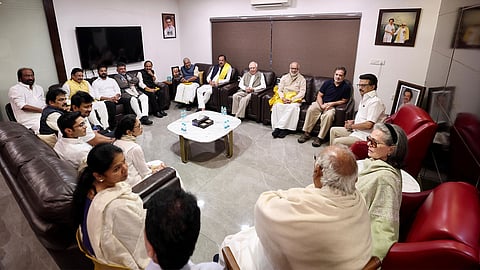
A high-level Opposition delegation, comprising Congress Parliamentary Party chairperson Sonia Gandhi, Leader of Opposition in the Lok Sabha Rahul Gandhi, Congress president Mallikarjun Kharge, MAITC chief Mamata Banerjee and other senior leaders, met Stalin at his residence in Chennai.
Karnataka Chief Minister DK Shivakumar, Kerala Chief Minister VD Satheesan, Telangana Chief Minister A Revanth Reddy and CPI(M) general secretary MA Baby were among the leaders involved in the Opposition's outreach.
The meeting came a day before Parliament reconvenes for a special sitting to consider the proposed constitutional amendments concerning delimitation and the implementation of women's reservation.
𝗗𝗠𝗞 𝘀𝘁𝗶𝗰𝗸𝘀 𝘁𝗼 𝗶𝘁𝘀 𝘀𝘁𝗮𝗻𝗱
The DMK had adopted a resolution on Saturday supporting the Centre's delimitation proposal after determining that key demands concerning Tamil Nadu's parliamentary representation had been addressed.
The party has maintained that Tamil Nadu's existing share of approximately 7.18 per cent in the Lok Sabha must be protected and that states which successfully implemented population control measures should not be penalised.
Under the proposed expansion, Tamil Nadu's Lok Sabha representation is expected to increase from 39 to 59 seats.
Ahead of Sunday's meeting, DMK MP Kanimozhi said she had already conveyed the party's position to Kharge, indicating that the leadership remained committed to the resolution adopted on Saturday.
Stalin also reiterated that the DMK would not compromise on the interests of Tamil Nadu and its people.
𝗥𝗮𝗵𝘂𝗹 𝗚𝗮𝗻𝗱𝗵𝗶'𝘀 𝗮𝗽𝗽𝗲𝗮𝗹
Before travelling to Chennai, Rahul Gandhi urged Stalin to join the Opposition in defeating the proposed constitutional amendments.
The Congress leader alleged that the proposed expansion of the Lok Sabha and subsequent redrawing of constituencies could provide an electoral advantage to the BJP.
He has demanded that the delimitation exercise be conducted on the basis of the upcoming 2027 Census under an impartial commission with representation from political parties.
The ruling BJP and its allies have rejected the Opposition's allegations, maintaining that expanding parliamentary representation would improve governance and facilitate the implementation of 33 per cent reservation for women ahead of the 2029 general elections.
𝗖𝗿𝗮𝗰𝗸𝘀 𝗶𝗻 𝗜𝗡𝗗𝗜𝗔 𝗯𝗹𝗼𝗰
The DMK's decision to support the delimitation proposal has exposed widening differences within the Opposition over the Centre's legislative agenda.
Relations between the Congress and the DMK have remained strained since the former withdrew from the DMK-led alliance following the April 2026 Tamil Nadu Assembly elections and joined the government led by TVK chief C Joseph Vijay.
The Opposition delegation is also scheduled to meet NCP (SP) chief Sharad Pawar in Mumbai on Sunday evening to persuade him to reconsider his party's support for the legislation.
Shiv Sena (UBT) chief Uddhav Thackeray has separately appealed to both Stalin and Pawar to reconsider their positions.
𝗖𝗿𝘂𝗰𝗶𝗮𝗹 𝗣𝗮𝗿𝗹𝗶𝗮𝗺𝗲𝗻𝘁 𝘀𝗶𝘁𝘁𝗶𝗻𝗴 𝗼𝗻 𝗠𝗼𝗻𝗱𝗮𝘆
The Centre is expected to introduce the Constitution (132nd Amendment) Bill, 2026, in the Lok Sabha on Monday, seeking to increase the maximum strength of the Lower House to 850 and freeze revised seat allocations until 2051.
As the legislation requires a special majority in both Houses of Parliament, the positions adopted by regional parties assume considerable significance.
The DMK's continued support for the proposal represents a setback to the Congress-led Opposition's efforts to present a united front against the proposed constitutional amendments.


