.png)
Nepal to bury unidentified flood victims after DNA sampling as morgues run out of space

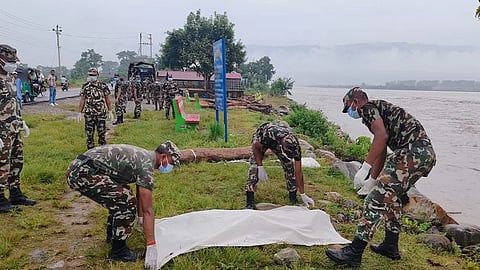
Nepalese authorities have decided to bury unidentified and unclaimed victims of the devastating flash floods after mortuaries and makeshift storage facilities ran out of space, even as families continue to search for missing relatives. The move comes amid mounting difficulties in preserving bodies recovered from rivers, mud and debris. Many remains have decomposed or are badly mutilated, making identification by sight nearly impossible.
At least 675 bodies had been recovered by Sunday morning, while the toll continued to rise as search teams found more victims. Chitwan, where large numbers of bodies were carried downstream by swollen rivers, has emerged as one of the centres of the identification crisis.
Mortuaries stretched beyond capacity
Chitwan alone received 233 bodies following the disaster, despite public and private hospitals in the district having combined mortuary capacity for only around 50. Authorities initially converted other facilities into temporary cooling and holding centres, but these too quickly became overwhelmed.
Of the hundreds of bodies recovered across Nepal, only a small number had been formally identified by relatives. More than 200 of the recovered remains were mutilated, partial or severed, according to police figures reported by local media.
Officials said bodies had travelled considerable distances from the areas where people disappeared, further complicating efforts to establish their identities. Some had remained trapped beneath mud or submerged in water for days before being recovered. With decomposition accelerating and authorities struggling to safely preserve the remains, emergency burial emerged as the only practical option in some of the worst-affected areas.
DNA collected before burial
The bodies will not simply be buried as unknown victims. Authorities have introduced a detailed forensic documentation process intended to make identification possible even months or years later. DNA samples are being collected before burial, and every body or set of remains is being assigned a unique identification number. Authorities are also preserving photographs, physical descriptions, autopsy and inquest records and information about clothing, jewellery, identity documents and other belongings recovered with the victims.
Where possible, investigators can also use fingerprints, dental information and other forensic evidence to establish identities. A 40-member medical team, including forensic specialists and dental surgeons, has been involved in identification work in Chitwan. More than 100 bodies had undergone DNA profiling by Saturday afternoon.
Graves designed to allow exhumation
Authorities are taking additional precautions to ensure individual bodies can be located and recovered if their identities are established later. Burial pits are being dug around 1.5 metres deep, while a gap of approximately 40 centimetres is being maintained between bodies. The separation is intended to allow authorities to exhume one particular victim without disturbing neighbouring remains.
Each body is being placed in a bag carrying its identification number. Corresponding markers will be installed at burial sites, while the process is being documented through photographs and video. The precise locations of graves are also being geo-tagged. In Chitwan, authorities selected a site at Devghat in Bharatpur Metropolitan City for the burials.
Families can seek DNA matches later
The system is designed to give families searching for missing relatives a route to identification even after burial. Relatives can provide DNA samples at designated hospitals. Those samples will be compared with genetic profiles collected from unidentified bodies. When a match is established, officials will use the victim's identification number and burial records to locate the grave.
The remains can then be exhumed and handed over to the family for final rites. Nepal Police has also placed information about unidentified and unclaimed bodies online and circulated access through a QR code, giving families another way to search available records. The painstaking documentation has become particularly important as a large number of people remain unaccounted for. With recovery operations continuing across flood-hit areas, authorities face the difficult task of locating the missing while ensuring that victims who cannot immediately be identified can eventually be returned to their families.

