.png)
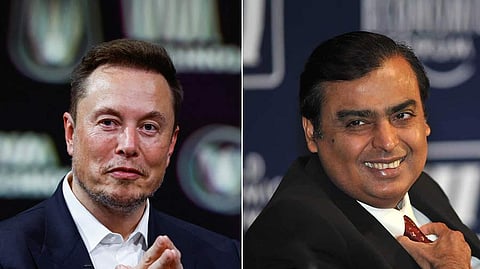
‘Is Ambani the boss of India?’: Musk questions Starlink delay as Centre rejects allegations of bias
A fresh confrontation has erupted between Elon Musk and India's telecommunications establishment after the SpaceX chief publicly questioned Reliance Industries chairman Mukesh Ambani's influence over the country's regulatory decisions, alleging that powerful business interests were preventing his satellite broadband venture, Starlink, from launching commercial services despite years of efforts to secure the necessary approvals.
The controversy intensified on Thursday when Musk, responding to discussions on his social media platform X, questioned why Starlink had still not received permission to begin commercial operations in India despite having spent nearly five years navigating the country's regulatory requirements. He claimed that the satellite internet provider had secured licences in more than 165 countries and complied with every applicable Indian law and government requirement, but continued to face unexplained delays.
"Is Ambani the real boss of India?" Musk asked, escalating an earlier accusation that influential business groups were attempting to protect their existing dominance over the country's telecommunications market. His remarks represented an unusually direct public challenge to one of India's most influential industrialists and brought renewed attention to the regulatory hurdles confronting foreign satellite communication providers.
The Ministry of Communications strongly rejected Musk's allegations, asserting that India's regulatory framework for satellite communications was fair, transparent and non-discriminatory. It maintained that the three companies seeking to provide non-geostationary satellite communication services were at broadly the same stage of the approval process and that none had received preferential treatment.
Government rejects allegations
In its response, the ministry explained that three entities had already been granted Global Mobile Personal Communication by Satellite licences, commonly known as GMPCS licences, under the framework governing satellite-based telecommunications services. However, obtaining such a licence did not automatically authorise an operator to begin commercial operations.
Each licensee must demonstrate compliance with mandatory security requirements intended to protect users, telecommunications infrastructure and sensitive data. These assessments were continuing for all three operators, the ministry said, adding that companies could proceed to seek spectrum assignment only after successfully completing the necessary security procedures.
The government described suggestions that the framework or its implementation discriminated against particular operators as baseless and misconceived. Its response sought to distinguish between the granting of preliminary regulatory permissions and the final authorisations necessary to deliver commercial satellite broadband services.
Starlink has already obtained important approvals, including a GMPCS licence from the Department of Telecommunications and authorisation from the Indian National Space Promotion and Authorisation Centre, or IN-SPACe. Nevertheless, outstanding security assessments and spectrum-related requirements have prevented the company from formally introducing its services to Indian consumers.
Musk targets telecom dominance
The dispute began escalating on Wednesday when Musk alleged that certain influential business interests were deliberately obstructing Starlink's entry to preserve their dominance over India's internet connectivity market. Although he initially refrained from identifying individual companies or industrialists, his subsequent reference to Ambani made the direction of his criticism explicit.
India's telecommunications market is dominated by Reliance Jio and Bharti Airtel, which together account for approximately four-fifths of the country's mobile subscriber base. Both companies have invested heavily in conventional mobile networks and are also pursuing opportunities in satellite-based communications.
Reliance Jio is developing satellite broadband capabilities through its partnership with Luxembourg-based satellite operator SES, while Bharti Airtel has significant interests in Eutelsat OneWeb, another satellite communications provider seeking to expand services in India.
Musk has argued that satellite broadband would primarily benefit people living in areas where conventional telecommunications infrastructure remains inadequate or economically difficult to establish. Such services could be particularly relevant to remote villages, mountainous regions, border settlements and other geographically isolated communities.
Unlike conventional mobile networks, which depend on terrestrial towers and extensive supporting infrastructure, low-Earth-orbit satellite systems can deliver internet connectivity through satellite terminals communicating with spacecraft orbiting hundreds of kilometres above the Earth.
However, satellite broadband is not necessarily a direct substitute for affordable mass-market mobile internet. Equipment costs, subscription charges, network capacity and regulatory restrictions could limit its immediate appeal among price-sensitive consumers. Its strongest potential lies in providing connectivity where conventional networks remain unavailable or unreliable.
Five years of regulatory hurdles
Starlink's attempts to establish a commercial presence in India date back to 2021, when the company began accepting advance bookings from prospective customers. The government subsequently warned that the company lacked the necessary authorisations to offer satellite internet services and directed it to stop taking bookings.
Starlink eventually refunded customers who had placed advance orders, while continuing its efforts to secure regulatory clearance.
A major breakthrough came in 2025 when the company obtained important statutory approvals and announced separate commercial arrangements with Reliance Jio and Bharti Airtel for distributing Starlink equipment and services in India, subject to regulatory permission.
The agreements were significant because they demonstrated that companies competing with Starlink in the emerging satellite broadband market were also prepared to collaborate with it commercially.
Under these arrangements, the Indian operators could potentially use their extensive retail and distribution networks to make Starlink equipment available to consumers and businesses once the service received permission to launch.
The partnerships also followed discussions between Musk and Prime Minister Narendra Modi during the latter's visit to the United States in February 2025, when satellite communications and technology cooperation featured among the subjects discussed.
Despite these developments, Starlink's commercial launch remained uncertain as regulators continued examining security-related obligations and technical compliance.
Security concerns remain central
One of the principal issues surrounding Starlink's entry has been the government's insistence on stringent security safeguards for satellite communication networks.
Unlike conventional terrestrial networks, satellite broadband systems operate through infrastructure that can extend across national boundaries. Regulators therefore require mechanisms to ensure lawful access to communications data, compliance with national security requirements and appropriate controls over network operations.
Indian authorities have also expressed concerns following the recovery of Starlink equipment during separate security-related operations in 2024, including a drug seizure in the Andaman and Nicobar Islands and a military operation in Manipur.
Musk previously maintained that Starlink's satellite beams had not been activated over India, rejecting suggestions that the company was knowingly providing unauthorised services in the country.
The discovery of satellite terminals nevertheless intensified scrutiny of how such equipment could be obtained, transported and potentially used without formal commercial authorisation.
The government's position is that satellite operators must satisfy security requirements before receiving the final permissions needed to serve customers. These obligations apply to domestic and foreign-backed operators alike.
Starlink highlights preparations
Starlink, meanwhile, has maintained that it has made substantial investments to prepare for operations in India and has developed systems intended to meet the country's security and data-handling requirements.
Speaking at India Mobile Congress 2026 in New Delhi on October 7, Starlink vice-president for business operations Lauren Dreyer said the company had established more than 20 gateway sites in India, supported by hundreds of antennas.
Gateway stations are essential components of satellite broadband infrastructure because they connect orbiting satellites with terrestrial internet networks and enable the transmission of data between users and the wider internet.
Dreyer said the company had also developed India-specific security controls and made arrangements to keep Indian users' data within the country, reflecting the importance of data sovereignty in the government's regulatory approach.
She emphasised that Starlink was prepared to support India's ambition of extending reliable connectivity to underserved communities and described satellite broadband as a complementary technology rather than a replacement for existing mobile and fibre networks.
These preparations, however, do not eliminate the requirement for independent regulatory verification before commercial services can begin.
Spectrum dispute preceded confrontation
The latest controversy follows an earlier disagreement between Starlink and established Indian telecommunications companies over the method of allocating satellite spectrum.
Reliance Jio had argued in favour of auctioning satellite spectrum, maintaining that competitive allocation was important to ensure fairness between satellite and terrestrial telecommunications providers.
Starlink and several other satellite operators favoured administrative assignment, arguing that satellite spectrum was technically different from spectrum used by conventional mobile networks and was generally coordinated and shared among operators.
The Indian government ultimately adopted an administrative assignment approach for satellite spectrum, consistent with the framework established under the Telecommunications Act, 2023, although operators remain subject to applicable charges and regulatory conditions.
That decision addressed one of the major policy disagreements surrounding satellite broadband, but it did not resolve the separate questions of security clearance and operational authorisation.
The present confrontation therefore concerns not simply the allocation of spectrum but the broader approval process governing the introduction of commercial satellite internet services.
Rahul Gandhi enters controversy
The dispute also acquired a political dimension after Leader of the Opposition Rahul Gandhi responded to Musk's remarks on X.
"Welcome to India, Elon. Wait till you discover the other guy," Gandhi wrote, appearing to extend his longstanding criticism of what he alleges is the close relationship between major corporate interests and the Union government.
Musk subsequently thanked Gandhi for his response and described the situation as troubling.
The exchange brought the Starlink licensing dispute into a wider political debate over corporate influence, competition and the government's treatment of large business groups.
However, Musk has not publicly produced evidence establishing that Ambani or Reliance Jio directly intervened to prevent Starlink from receiving regulatory approval. The government has explicitly denied that the approval process favours particular operators.
Bharti Enterprises chairman Sunil Bharti Mittal also pointed out that Bharti's satellite communications business was awaiting the necessary approvals, reinforcing the government's contention that regulatory delays were not confined to Starlink.
Reliance did not immediately issue a public response to Musk's latest remarks.
Commercial stakes are substantial
India represents an important potential market for satellite broadband operators because of its vast population, expanding digital economy and persistent connectivity gaps in remote regions.
Although the country has built one of the world's largest mobile internet markets, reliable high-speed access remains uneven in geographically challenging areas. Satellite connectivity could help bridge some of these gaps, particularly where laying fibre cables or building telecommunications towers is prohibitively expensive.
Consultancy firm Deloitte has projected that India's satellite broadband market could reach approximately $1.9 billion by 2030, highlighting the commercial opportunities available to operators capable of obtaining regulatory clearance and developing affordable services.
For Starlink, entering India would also represent an important expansion of SpaceX's global satellite communications business. The company operates an extensive low-Earth-orbit satellite constellation and has been seeking to increase its international subscriber base.
For Indian operators, satellite communications offer an opportunity to extend existing connectivity services, serve enterprise customers and strengthen coverage in locations where terrestrial networks are insufficient.
The controversy has also emerged against the backdrop of preparations for a potential public listing of Reliance Jio, which market observers expect to be among India's largest initial public offerings. However, there is no established evidence that the timing of Musk's criticism is connected to the proposed listing.
Uncertain launch timeline
The confrontation has added another dimension to an already complicated regulatory process involving commercial competition, national security, spectrum management and international technology investment.
The United States has also advocated greater market access for American technology companies, including satellite communication providers, giving Starlink's India ambitions a wider diplomatic context.
Nevertheless, India's regulatory authorities retain responsibility for determining whether individual operators have fulfilled the conditions necessary to provide telecommunications services within the country.
For now, Starlink remains unable to begin commercial satellite broadband operations despite securing important preliminary approvals, developing ground infrastructure and entering distribution partnerships with India's leading telecommunications companies.
The government has indicated that the next stage of the process will depend on the successful completion of mandatory security assessments, but has not announced a definitive timetable for final clearance.
The unresolved question is whether the remaining regulatory requirements can be completed expeditiously while maintaining the security safeguards the government considers essential. Until then, Musk's allegations of corporate obstruction and the Centre's insistence on equal regulatory treatment are likely to remain at the centre of the debate over India's emerging satellite broadband market.


