.png)
India’s nuclear arsenal estimated at 190 warheads, 30 meant for new missiles under production
India is estimated to possess up to 190 assembled nuclear warheads, including around 30 intended for new missiles currently under production, according to a new assessment that points to the continuing expansion and modernisation of the country’s nuclear deterrent.
The latest edition of the Nuclear Notebook, prepared by researchers from the Federation of American Scientists’ Nuclear Information Project and published in the Bulletin of the Atomic Scientists, estimates that India’s operational forces can deliver more than 160 nuclear warheads. Additional warheads are believed to have been produced for newer missile systems, taking the estimated total inventory to as many as 190. The Indian government does not publicly disclose the size of the country’s nuclear stockpile, making such figures independent estimates based on open-source information.
Plutonium could support larger arsenal
The researchers estimate that India may have produced enough military plutonium for between 140 and 225 nuclear warheads, although not all available fissile material is believed to have been converted into weapons. Some material is likely being retained in reserve.
India is also continuing production of plutonium and highly enriched uranium, potentially providing the material required for further expansion of its arsenal. The assessment notes that the Prototype Fast Breeder Reactor could eventually increase the availability of plutonium, although the extent to which such material might be used for weapons remains uncertain.
The report represents a significant increase from the Nuclear Notebook’s 2024 estimate, when researchers assessed that India had assembled around 172 warheads. Separately, the Stockholm International Peace Research Institute estimated earlier this year that India possessed around 190 nuclear weapons as of January 2026.
Nine nuclear-capable systems operational
India currently operates nine different nuclear-capable delivery systems, according to the latest assessment — two aircraft, six land-based ballistic missiles and one sea-based ballistic missile system. At least two additional systems are under development and approaching completion, with researchers expecting them to enter service within the next few years.
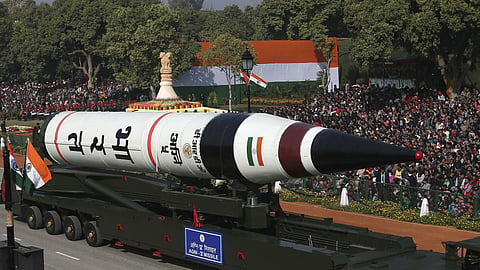
The country is simultaneously expanding the sea-based component of its nuclear triad and deploying increasingly capable land-based missiles. The Agni-V, a three-stage, solid-fuel, road-mobile missile with a range of less than 6,000 km, is capable of carrying multiple independently targetable re-entry vehicles. Its longer reach would allow deployment from central and southern India while retaining the ability to cover targets farther away.
India continues to officially maintain its doctrine of credible minimum deterrence and a no-first-use nuclear policy. However, researchers say the modernisation of delivery systems, deployment of canisterised missiles and expansion of the submarine-based deterrent are gradually increasing the readiness and sophistication of the country’s nuclear forces.


