.png)
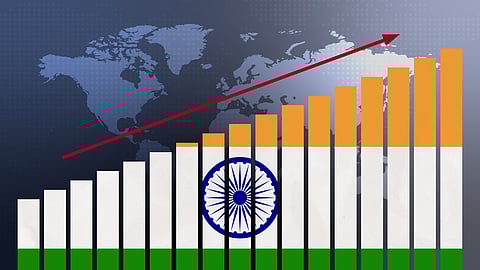
India surpasses Japan in GDP rankings; government projects to become the 3rd largest economy by 2030

As 2025 drew to a close, India edged past Japan to become the world’s fourth-largest economy, according to the government’s end-of-year economic assessment. Official figures indicate that India’s nominal GDP has touched USD 4.18 trillion, placing it only behind the United States, China and Germany. The ambition now is to move ahead of Germany within the next three years, marking another milestone in India’s economic rise.
A formal confirmation will come only after final GDP numbers for 2025 are compiled in 2026, but projections from the International Monetary Fund suggest the transition has effectively taken place. IMF estimates indicate that India’s economy will reach USD 4.51 trillion in 2026, surpassing Japan’s forecast GDP of USD 4.46 trillion for the same period.
India’s annual economic review stated that the country remains one of the fastest-growing major economies globally and is “well-positioned” to maintain its pace. With GDP now estimated at USD 4.18 trillion, the report notes that India has overtaken Japan and is likely to claim the third position globally within the next two to three years, with the economy projected to grow to USD 7.3 trillion by 2030. This confidence comes despite external economic pressures, including steep tariffs imposed by the United States in August over India’s imports of Russian crude oil. New Delhi maintains that its economic trajectory highlights resilience and the ability to withstand global shocks.
India first rose to the position of the world’s fifth-largest economy in 2022, when it overtook the United Kingdom, according to IMF assessments.
Challenges That Remain
India surpassed China in 2023 to become the world’s most populous country. Yet, while its economic size has grown, the US remains the largest economy, followed by China and Germany. India’s per capita GDP, however, remains significantly lower. World Bank data for 2024 pegs India’s per capita income at USD 2,694 — far below Japan’s USD 32,487 and Germany’s USD 56,103, underscoring the need for more inclusive economic growth.
With more than 25 per cent of its 1.4 billion citizens aged between 10 and 26, India faces a critical challenge — ensuring meaningful and well-paid employment for millions of young people entering the workforce. Meanwhile, the rupee touched a record low against the US dollar in early December, reflecting concerns about the absence of a trade deal with Washington and the impact of American tariffs on Indian exports.
Growth Outlook
The government has stressed that as one of the youngest nations in the world, India’s future depends heavily on its ability to create productive jobs, sustain growth and ensure social inclusion. Global financial institutions appear optimistic. The World Bank has projected GDP growth of 6.5 per cent in 2026. Moody’s expects India to remain the fastest-growing economy in the G20, forecasting 6.4 per cent growth in 2026 and 6.5 per cent in 2027.
The IMF recently revised India’s growth projection to 6.6 per cent for 2025 and 6.2 per cent for 2026. The OECD has forecast 6.7 per cent growth in 2025 and 6.2 per cent in 2026. S&P predicts growth of 6.5 per cent in the current financial year and 6.7 per cent in the next, while the Asian Development Bank has upgraded its 2025 projection to 7.2 per cent. Fitch Ratings has raised its FY26 forecast to 7.4 per cent, attributing the optimism to strong domestic demand.
The government says India is among the fastest-expanding economies globally and remains on track to sustain this momentum. With a long-term vision of achieving high middle-income status by 2047, the centenary of independence, India is banking on consistent growth, structural reforms and continued social development.
Earlier this year, Prime Minister Narendra Modi announced sweeping consumption tax reductions and advanced labour reforms after growth slipped to a four-year low in the financial year ending March 31 — an attempt to stabilise momentum while safeguarding long-term economic ambition.

