.png)
How Rahul Gandhi pulled off his surprise protest at the PM's residence

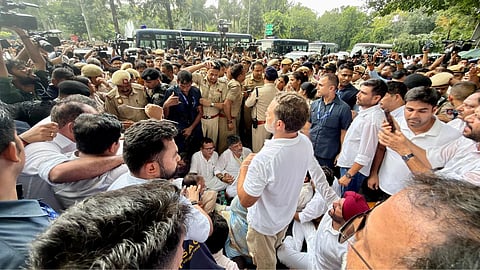
Rahul Gandhi's sit-in outside Prime Minister Narendra Modi's residence on Tuesday was not merely another Opposition protest. It was a carefully choreographed political operation that relied on surprise, dispersed mobilisation and institutional legitimacy to breach one of Delhi's most tightly controlled political zones. By the time Delhi Police realised the scale of the mobilisation, senior Congress leaders, Opposition allies and hundreds of workers had already reached the barricades near 7, Lok Kalyan Marg, transforming what could have been a routine detention into a nationally televised political confrontation.
The operation appears to have rested on five strategic pillars.
1. Extreme Operational Secrecy
Unlike conventional Congress demonstrations, there was little advance public mobilisation. There were no mass calls asking workers to gather directly outside the Prime Minister's residence. Instead, leaders assembled at Congress president Mallikarjun Kharge's residence at 10 Rajaji Marg before beginning the march. This reduced the time available for police to seal approach roads or detain leaders before they converged.
Political strategists note that Delhi Police generally responds to announced protests through preventive detentions and route restrictions. Keeping the final destination effectively under wraps until the last moment narrowed that window.
2. Parliament as a Shield
The protest came while Parliament was in session, allowing the Congress to leverage the presence of MPs already in Delhi. Members of Parliament enjoy greater political visibility than ordinary protesters, making preventive action significantly more sensitive.
The participation of Rahul Gandhi, Priyanka Gandhi Vadra, Mallikarjun Kharge, Samajwadi Party chief Akhilesh Yadav and Congress chief ministers raised the political cost of an immediate crackdown. Any forcible removal risked creating images of senior constitutional functionaries being dragged away.
3. Turning Monday's Crackdown into Tuesday's Narrative
The timing was central to the strategy.
Only a day earlier, videos showing police action against student protesters had spread rapidly across social media despite official denials. Rather than organise another student demonstration, the Congress reframed the issue as one of democratic rights.
Rahul Gandhi positioned the sit-in as a protest against alleged police brutality and demanded accountability directly from the Prime Minister, shifting the political spotlight from the Education Ministry to the Prime Minister's Office itself.
This transformed what began as a student agitation into a larger constitutional confrontation over dissent and state power.
4. Forcing an Institutional Response
Perhaps the biggest tactical success was compelling a response from the government.
Instead of relying solely on police action, Union Minister of State in the Prime Minister's Office Jitendra Singh personally met Rahul Gandhi at the protest site and held discussions for several minutes. Such engagement is unusual outside the Prime Minister's residence and immediately elevated the protest's political significance.
For the Congress, the meeting itself became evidence that the government could not simply ignore the demonstration.
5. Optics Over Occupation
The protest was never designed to physically reach the Prime Minister's residence.
Security around 7, Lok Kalyan Marg makes that virtually impossible. The Prime Minister's residential complex is protected by multiple security rings under the Special Protection Group, with heavily restricted access and layered checkpoints.
Instead, the objective was visual.
Images of Opposition leaders sitting within sight of the Prime Minister's security perimeter created a powerful symbolic message. Even after police removed the protesters later in the evening, the Congress had already secured hours of uninterrupted national television coverage and viral social media footage.
A Shift in Rahul Gandhi's Protest Politics
The episode also illustrates Rahul Gandhi's evolving political style.
In recent years, his politics has increasingly relied on symbolic interventions rather than prolonged street mobilisation. Whether during the Bharat Jodo Yatra, his parliamentary speeches or issue-based demonstrations, the emphasis has been on creating high-impact visual moments that dominate the news cycle.
Tuesday's protest followed the same template: limited numbers, high-profile participants, maximum symbolism and a clear political target.
What It Means
For the government, the incident exposed the difficulty of managing spontaneous political mobilisation in the heart of the capital without creating damaging visuals.
For the Congress, it demonstrated that even without overwhelming organisational strength on Delhi's streets, it can still seize the political initiative through surprise tactics and careful choreography.
The larger lesson may be that in contemporary politics, success is measured less by how long a protest lasts than by how effectively it reshapes the day's national conversation. On that count, Rahul Gandhi's operation outside the Prime Minister's residence achieved precisely what it set out to do.

