.png)
Erasing Discomfort or Teaching Truth? The NCERT Debate Tests India’s Civic Education Vision

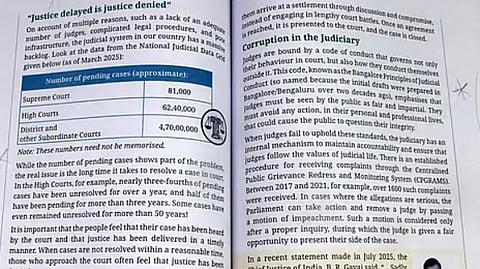
The controversy surrounding references to judicial corruption in an NCERT Class 8 textbook has reopened a familiar fault line in India’s public life: the tension between protecting institutional credibility and acknowledging institutional shortcomings. The swift removal of the book from the NCERT website, the Supreme Court’s suo motu cognisance, and government discomfort with the framing of the chapter signal how sensitive the subject remains. Yet beyond the immediate dispute lies a deeper question about what civic education in a democracy should look like. Should textbooks present institutions as unimpeachable pillars, or should they equip students to understand that accountability and transparency are integral to institutional strength?
India’s judiciary commands immense respect, and rightly so. It has played a decisive role in safeguarding constitutional values, expanding fundamental rights, and acting as a check on executive overreach. From the basic structure doctrine to landmark judgments on privacy, environmental protection, and civil liberties, the courts have often served as the last refuge for citizens. This legacy explains why any suggestion of judicial impropriety provokes strong reactions. However, reverence alone cannot sustain public trust. Trust in democratic institutions is built not on claims of infallibility but on visible mechanisms of accountability. Acknowledging challenges such as case backlogs, vacancies, and complaints processes does not weaken the judiciary; it situates it within the reality of a complex system striving to function under pressure.
The data cited in the disputed chapter — including the staggering pendency of cases across courts and thousands of complaints against judges over the years — is not fabricated; much of it exists in parliamentary records and official databases. India’s judicial backlog, now running into crores of cases in subordinate courts, is widely recognised as one of the most pressing governance challenges. Delayed justice erodes faith not because citizens doubt the integrity of judges, but because the system struggles to deliver timely outcomes. Similarly, the existence of complaint mechanisms and in-house procedures reflects an institutional acknowledgment that oversight is necessary. Presenting these realities to students, if done with nuance, can foster informed respect rather than blind faith.
The government’s argument that discussions of corruption should encompass all three organs of the state — legislature, executive, and judiciary — is not without merit. Selective scrutiny risks distorting students’ understanding of governance by isolating one institution from the broader ecosystem in which accountability must operate. Corruption, after all, is not confined to any single branch of government; it is a systemic challenge that requires institutional checks, transparency laws, and civic vigilance. A balanced curriculum would therefore situate judicial accountability within a wider framework of democratic ethics, highlighting the roles of Parliament, independent watchdogs, investigative agencies, and civil society. Such an approach would prevent the perception of targeting while preserving the essential lesson: no institution in a democracy is beyond scrutiny.
What is troubling, however, is the instinct to respond to controversy by erasing uncomfortable content rather than refining it. Democracies do not become stronger by avoiding difficult conversations. Around the world, civic education increasingly emphasises critical thinking, media literacy, and institutional analysis. Students are encouraged to understand how systems function, where they falter, and how citizens can participate in reform. Shielding young learners from these realities may offer short-term reputational comfort but risks producing a generation ill-equipped to engage with democratic processes. Respect for institutions grows when citizens understand both their achievements and their imperfections — and recognise their own role in strengthening them.
The Supreme Court’s concern about defamation and loss of public confidence is understandable. Institutions rely on legitimacy, and careless or poorly contextualised material can damage that legitimacy. The solution, however, lies not in silence but in precision. Textbooks must distinguish between systemic challenges and individual misconduct, between verified data and anecdotal claims, and between critique and cynicism. They must also highlight the judiciary’s internal safeguards, ethical standards, and corrective mechanisms. By presenting a complete picture, educators can ensure that students see institutions as resilient frameworks capable of self-correction rather than fragile entities that cannot withstand scrutiny.
Ultimately, the NCERT episode is less about one chapter and more about the philosophy of civic education in India. A confident democracy does not fear informed citizens; it depends on them. Teaching students about accountability, transparency, and institutional processes does not erode trust — it deepens it by aligning expectations with reality. If the goal of education is to nurture thoughtful, responsible citizens, then classrooms must be spaces where difficult truths are explored with balance and care, not avoided.
India stands at a moment when institutional trust is both vital and contested. Preserving that trust requires more than defending reputations; it requires demonstrating that institutions are open to scrutiny, committed to reform, and grounded in constitutional values. Textbooks, as the first interface between young citizens and the state, play a crucial role in shaping this understanding. Rather than sanitising complexity, they should illuminate it — teaching students that democracy is not the absence of flaws, but the continuous effort to confront and correct them.

