.png)
11 Chinese J-20 stealth jets spotted near India in biggest deployment yet
China has significantly increased the operational deployment of its frontline J-20 "Mighty Dragon" stealth fighter aircraft at airbases close to the Line of Actual Control (LAC), according to recent satellite imagery, underscoring the People's Liberation Army Air Force's (PLAAF) growing focus on its western theatre.
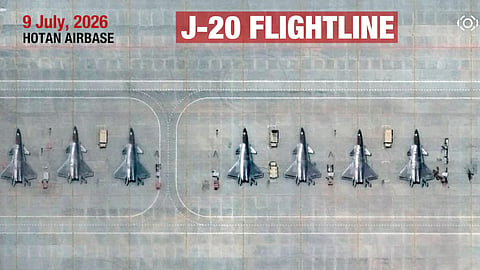
Satellite images from late June and early July, sourced from Vantor, indicate that at least 11 J-20 fighters were stationed across two strategic airbases facing India.
The largest concentration was observed at Hotan airbase in Xinjiang, where seven J-20s were visible on the tarmac in imagery captured on July 9. The dual-use military and civilian base is located around 389 km from Leh and approximately 245 km from the Indian Air Force's Daulat Beg Oldie airfield in eastern Ladakh. Analysts say this is the highest number of J-20s seen simultaneously at a Chinese airbase oriented towards India.
A second set of images showed four J-20s parked at Damxung airbase in Tibet's Lhasa prefecture, roughly 344 km from Tawang in Arunachal Pradesh, another strategically sensitive sector along the India-China border.
Defence experts believe the deployment reflects a shift from symbolic positioning to sustained frontline operations.
Former fighter pilot and NewSpace co-founder Sameer Joshi said the regular presence of fifth-generation fighters at high-altitude airbases indicates that the PLAAF has made such deployments part of its routine operational posture rather than temporary signalling.
He noted that for the Indian Air Force (IAF), the presence of stealth aircraft along the northern frontier raises the importance of strengthening counter-stealth detection systems, integrated air defence networks and long-range precision strike capabilities.
The J-20 is China's premier fifth-generation combat aircraft and is designed with stealth features intended to reduce its radar signature. Its low-observable characteristics provide it with an advantage in contested airspace over conventional fourth-generation fighters.
India currently does not field an operational stealth fighter. The indigenous Advanced Medium Combat Aircraft (AMCA), India's first planned fifth-generation fighter, remains under development and is expected to take several years before entering squadron service after completing flight testing and technology validation.
China's expanding J-20 fleet has also drawn international attention. Recent assessments indicate production has accelerated sharply over the past few years. Estimates suggest the fleet has grown from around 50 aircraft in 2019 to several hundred today, with annual production now believed to exceed 100 aircraft. Some defence analysts estimate that China may already have between 300 and 500 J-20s in service, while projections by the UK-based Royal United Services Institute suggest the number could approach 1,000 by 2030.
Retired Air Marshal Narmdeshwar Tiwari said China's ability to manufacture more than 120 advanced fighter aircraft annually reflects a highly integrated aerospace ecosystem.
According to him, such production rates are possible only when the manufacturing supply chain, industrial precision and skilled workforce operate seamlessly. He said China has pursued military aviation as a long-term national mission, investing consistently in capability development since recognising the decisive role of air power after the first Gulf War.
Satellite imagery over the past decade has shown a gradual increase in J-20 activity across Chinese airbases in Tibet and Xinjiang. Earlier reports documented the aircraft at Daocheng Yading airport in 2016, while images from 2024 showed J-20 operations at Shigatse airbase near the Sikkim sector.
On the Indian side, the IAF currently operates 36 Rafale fighter jets across two squadrons based at Ambala in Haryana and Hasimara in West Bengal. The force also fields more than 260 Sukhoi Su-30MKI aircraft, alongside Mirage 2000 and MiG-29 fighters. The Indian Navy has contracted 26 Rafale-M jets, while discussions continue on the proposed acquisition of 114 additional multirole fighters for the IAF.
The Indian Air Force has not officially commented on the reported Chinese deployments.


