.png)
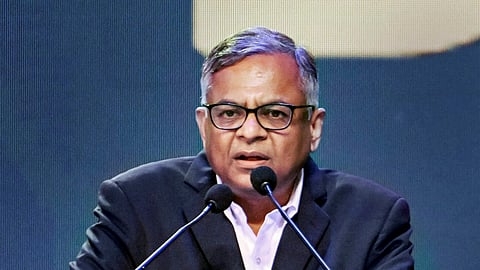
'You cannot be reckless': Tata Sons chief on India's semiconductor ambitions
Semiconductors will be fundamental to India's future, and the country is well placed to emerge as a key part of the global supply chain, given its talent pool, large domestic market and potential international partnerships, Tata Sons Chairman N Chandrasekaran said on Tuesday.
Speaking at the 2026 Bloomberg New Economy Forum, N Chandrasekaran emphasised that the 160-year-old Tata Group's true priority is to position itself in an industry that is "fundamentally required" to meet domestic consumption needs.
India well placed to join global semiconductor supply chain
Chandrasekaran said India was in a favourable position to develop its semiconductor manufacturing capabilities, given its talent pool, large domestic market and ability to participate in global supply chains.
"... We are in a beautiful spot in India, because we have the talent, we have the domestic market, we can play a part in every global supply chain," he said.
Emphasising the importance of partnerships in building the ecosystem, Chandrasekaran said India would need to collaborate with global players to access the necessary technologies while closely monitoring energy requirements.
"We need partnerships, because we have all the technologies... But if you design it, definitely we will get there. But you also have to be careful, because you need to keep an eye on energy," he said.
Tata Group's semiconductor investments
Tata Electronics, a group company, is setting up a semiconductor fabrication plant at Dholera in Gujarat in partnership with Taiwan's Powerchip Semiconductor Manufacturing Corporation (PSMC), with an investment of around Rs 91,000 crore.
The proposed facility will manufacture chips for applications spanning automobiles, mobile devices, consumer electronics, artificial intelligence and other industrial segments.
The group is also developing a semiconductor assembly and test facility in Assam with an investment of around Rs 27,000 crore. The projects are aimed at meeting growing domestic demand, strengthening India's semiconductor supply chain and integrating the country more closely with the global electronics manufacturing ecosystem.
The semiconductor push is part of Tata Group's broader strategy to expand its presence in advanced manufacturing, electronics and battery technologies.
Chandrasekaran cautions against risky investments
Chandrasekaran said such investments reflected the group's conviction that semiconductor capabilities would be essential in the long run, even as the pace of execution and the choice of technologies remained uncertain.
However, he cautioned against pursuing the most advanced chip-manufacturing technologies without adequately assessing market demand and economic viability.
"You cannot be reckless and say that I am going to be putting a 2 nanometre chip (plant). It's just not going to work. So, we need to also see where the demand is," he said.
He said financial metrics were important for India, businesses and people, stressing that investments should be commercially viable and capable of generating sustainable employment over the long term.
"And the financially viable thing, you have got to see the sun cross the river," said Chandrasekaran, who was recently given a third five-year term as Tata Sons Chairman amid a boardroom tussle over the group's future.
Acknowledging uncertainties in the global business environment, Chandrasekaran said businesses could not expect every aspect of an investment to be predictable.
"But a lot of things are certain. Energy is certain, the game is certain, the ability to execute is certain. And the only thing is how much you ramp up, how fast you ramp up, which technology you go to...," he said.


