.png)
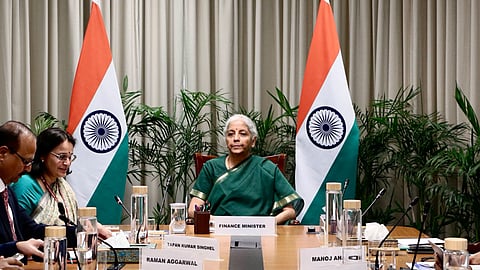
Sitharaman holds fifth pre-Budget meet with capital markets, BFSI stakeholders
Union Finance Minister Nirmala Sitharaman on Wednesday chaired the fifth round of pre-Budget consultations with stakeholders from capital markets, banking, financial services and insurance (BFSI) sectors as preparations gathered pace for the Union Budget 2027-28.
The meeting formed part of the Finance Ministry's annual consultation exercise aimed at gathering suggestions from different sectors of the economy before finalising the government's fiscal priorities and Budget proposals.
Representatives of the financial sector were given an opportunity to present their views on policy requirements, regulatory concerns and measures that could support investment and financial-sector development.
The Finance Ministry confirmed that Sitharaman chaired the fifth consultation in New Delhi, bringing together stakeholders from capital markets and the BFSI sector.
The discussions came two days after the Finance Minister began the consultation process with leading economists on November 16.
𝐂𝐚𝐩𝐢𝐭𝐚𝐥 𝐦𝐚𝐫𝐤𝐞𝐭𝐬 𝐢𝐧 𝐟𝐨𝐜𝐮𝐬
The meeting provided a platform for capital market participants to highlight issues affecting investors, market intermediaries and financial institutions.
Ahead of the consultations, industry representatives were expected to raise concerns relating to the taxation of equity investments and the cost of securities transactions.
Issues involving long-term capital gains tax, short-term capital gains tax and securities transaction tax were among the subjects expected to feature in industry representations.
Market participants have previously sought changes to the taxation framework, including rationalisation of securities transaction tax and revisions to capital gains tax provisions.
However, the government had not immediately disclosed the specific recommendations submitted during Wednesday's meeting or indicated whether any proposals would be incorporated into the forthcoming Budget.
𝐁𝐚𝐧𝐤𝐢𝐧𝐠, 𝐢𝐧𝐬𝐮𝐫𝐚𝐧𝐜𝐞 𝐬𝐞𝐜𝐭𝐨𝐫𝐬 𝐣𝐨𝐢𝐧 𝐭𝐚𝐥𝐤𝐬
Representatives from banking, financial services and insurance also participated in the consultation process.
The engagement allowed stakeholders to present their assessments of sectoral challenges and suggest measures that could improve financial intermediation, investment flows and access to financial services.
The BFSI sector plays an important role in supporting economic activity by mobilising savings, facilitating credit and providing financial protection to households and businesses.
Inputs from these sectors are considered during Budget preparation alongside recommendations from economists, industry organisations and other stakeholders.
The consultation exercise does not necessarily mean that all industry proposals will be accepted, as the Finance Ministry must evaluate them against fiscal priorities, revenue implications and implementation requirements.
𝐁𝐮𝐝𝐠𝐞𝐭 𝐜𝐨𝐧𝐬𝐮𝐥𝐭𝐚𝐭𝐢𝐨𝐧𝐬 𝐠𝐚𝐭𝐡𝐞𝐫 𝐩𝐚𝐜𝐞
Sitharaman began the pre-Budget exercise on Monday with discussions involving leading economists and representatives of agriculture and rural development.
The consultations continued on Tuesday with stakeholders from manufacturing, micro, small and medium enterprises (MSMEs) and the startup ecosystem.
The Finance Ministry has scheduled interactions with 14 stakeholder groups between November 16 and 26.
Representatives from information technology, infrastructure, energy and sustainability are scheduled to participate in subsequent discussions, followed by groups associated with employment, labour, housing, healthcare and education.
For the first time, the consultation programme will also formally include young people, providing students, youth leaders and young professionals an opportunity to present their expectations from the Union Budget.
𝐁𝐮𝐝𝐠𝐞𝐭 𝐞𝐱𝐩𝐞𝐜𝐭𝐞𝐝 𝐨𝐧 𝐅𝐞𝐛𝐫𝐮𝐚𝐫𝐲 𝟏
Sitharaman is expected to present the Union Budget 2027-28 on February 1, 2027.
The Budget will outline the Centre's estimated revenue and expenditure for the next financial year, along with taxation proposals, sectoral allocations and policy measures.
The Economic Survey, which assesses the country's economic performance and outlines key challenges, is expected to be tabled ahead of the Budget.
The ongoing consultations are intended to help the government assess sector-specific demands and wider economic priorities before finalising its financial roadmap for 2027-28.


