.png)
Rooftop solar, PM-KUSUM drive 40% of India’s capacity additions in FY27
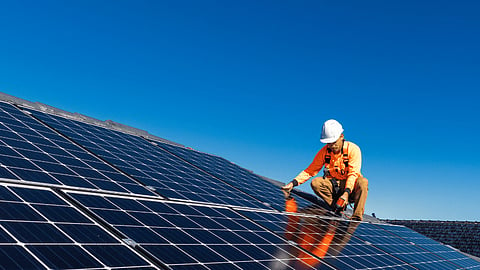
Rooftop solar installations and projects under the PM-KUSUM programme together accounted for around 40 per cent of India's new solar capacity additions in the first four months of 2026-27, highlighting the growing role of decentralised renewable energy in the country's clean-energy expansion, according to a Bernstein report.
The trend marks a shift in India's solar growth story, which has traditionally been dominated by large utility-scale projects. Stronger adoption of rooftop systems and agricultural solar installations is helping broaden capacity additions while taking renewable generation closer to households, businesses and farms.
Distributed solar gains ground
Bernstein said rooftop solar and KUSUM installations contributed a substantial share of the country's incremental solar capacity through July. The growth reflects increased activity under government programmes designed to encourage households and farmers to adopt solar power.
Rooftop installations have received a boost from the PM Surya Ghar Muft Bijli Yojana, which provides financial assistance to households installing solar systems. The programme seeks to lower consumers' electricity expenses while expanding small-scale generation across the country.
PM-KUSUM, meanwhile, is targeted largely at the agricultural sector and supports solar-powered irrigation pumps as well as decentralised renewable-energy projects. The programme is intended to reduce farmers' dependence on conventional electricity and diesel while expanding clean-energy generation in rural areas.
Utility projects remain crucial
Large solar parks and other utility-scale projects continue to account for the majority of capacity additions, but the rising contribution from smaller installations indicates that India's renewable-energy market is becoming more diversified.
Distributed solar offers several advantages because electricity can be generated close to where it is consumed. This can reduce dependence on grid-supplied power and potentially ease pressure on distribution infrastructure, although rapid adoption also requires improvements in grid management, metering and electricity distribution systems.
The expansion is also creating opportunities across the solar supply chain, including modules, inverters, installation services, financing and maintenance.
Solar push broadens
India has been rapidly adding renewable-energy capacity as it works towards its longer-term clean-energy and climate objectives. Solar power remains central to that transition because of falling technology costs, improving domestic manufacturing capabilities and strong policy support.
The growing contribution of rooftop and agricultural solar could make future capacity additions less dependent on the timelines associated with large projects, which can face challenges involving land acquisition, transmission connectivity and approvals.
Bernstein's assessment suggests decentralised solar is becoming an increasingly important component of India's energy transition. Sustaining the momentum will depend on effective implementation of government schemes, financing availability and the ability of distribution companies and grid infrastructure to accommodate a growing number of smaller generating systems.


