.png)
Piyush Goyal warns ‘black sheep’ automakers over low localisation in India

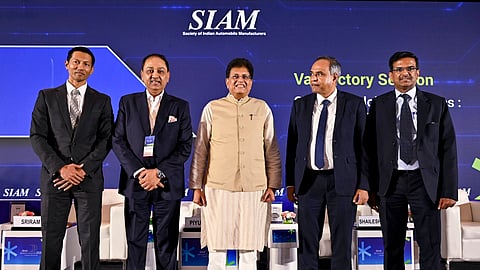
Commerce and Industry Minister Piyush Goyal on Thursday cautioned automakers against inadequate localisation, saying there were a “few black sheep” in the industry whose indigenisation efforts were being closely watched by the government.
Addressing an event of the Society of Indian Automobile Manufacturers (SIAM), Goyal said some companies claimed to be increasing localisation by establishing another entity in India that imported products at nominal value before supplying them for vehicles sold in the domestic market. “There are, of course, a few black sheep also; I will not name anybody. They need to really look up their indigenisation programme afresh,” Goyal said.
The minister contrasted such practices with Japanese automakers that, he said, had forged partnerships in India, created supplier ecosystems and progressively increased local manufacturing while producing globally competitive vehicles.
AI tracking imports
Goyal warned automakers that the government had access to detailed company-wise trade information and was increasingly using artificial intelligence to analyse imports and exports. “You may not realise it, but I’m watching surely the level of indigenisation,” he said, adding that the government could use companies’ Importer Exporter Code (IEC) numbers to analyse their trade patterns.
Goyal said localisation claims could be checked by examining not only the automaker’s imports but also those of companies within its supplier ecosystem and linking their IEC data. Where certain components cannot immediately be localised, the minister urged companies to compensate by increasing exports. He assured the industry that the government was prepared to provide support and create the necessary enabling environment.
Goyal praised Maruti Suzuki India for its export performance, noting its significant contribution to the nearly one million passenger vehicles exported from the country last year. Maruti Suzuki exported 4.47 lakh vehicles in 2025-26 and accounted for around 55 per cent of passenger vehicle exports during the April-June quarter of the current fiscal.
‘Think globally’
Calling the automobile sector a critical driver of India’s future growth, Goyal urged manufacturers not to remain satisfied with the domestic market and instead “think globally”. He said competition would intensify as more international automakers entered India, making it necessary for domestic manufacturers to use the country’s scale to serve overseas markets.
Goyal predicted that manufacturing would increasingly move away from developed economies because of high costs, regulatory burdens, ageing populations, talent shortages and inadequate industrial capacities. Companies that anticipated this shift and invested accordingly would gain, while those remaining comfortable in their existing businesses risked being left behind, he said.
The minister also cautioned manufacturers against offering Indian consumers products of a lower standard than those sold internationally. Referring to instances where vehicles designed for India were reportedly considered unsuitable for exports, he said automobiles manufactured in the country should meet global standards.
Exports, technology in focus
Goyal urged the industry to deepen investment in technology, innovation and research and development while using India’s expanding network of trade agreements to increase exports.
He said India needed an additional around USD 29 billion to reach its USD one trillion export target for 2026-27 over the remaining seven months and called upon industry to raise the monthly pace of export growth.
Artificial intelligence, he said, would improve efficiency, competitiveness and customer service in the automobile industry while also creating new kinds of employment. “Job roles may change, but jobs will grow,” he said.
Goyal also outlined what he described as the “four Ms of mobility” — molecules, modules, megawatts and markets. He highlighted the importance of securing rare earths and critical minerals, reducing dependence on imported components, achieving greater energy self-sufficiency and expanding access to international markets.
The government, he added, was willing to support large automobile and component manufacturing projects through land and plug-and-play infrastructure and could facilitate country-specific industrial parks based on industry requirements.

