.png)
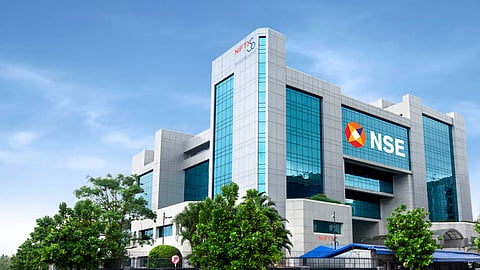
NSE likely to price IPO around Rs 1,800; listing by September 25
The National Stock Exchange of India (NSE) has received regulatory clearance for its long-awaited initial public offering, paving the way for an issue estimated at around Rs 30,000 crore that could become the country’s biggest IPO to date. The Securities and Exchange Board of India (SEBI) issued its observation letter to the exchange, effectively allowing the offer to proceed, according to an update on the regulator’s website on Friday. The IPO will comprise an offer for sale (OFS) of up to 14.89 crore shares, representing roughly 6 per cent of NSE’s paid-up capital. At an estimated price of around Rs 2,000 per share, the offering could raise close to Rs 30,000 crore and value the exchange at more than Rs 5 lakh crore. Since the issue is entirely an OFS, NSE will not receive any proceeds, with the money instead going to existing shareholders selling their stakes.
The exchange is expected to announce the price band and other key details next week. Sources said the IPO could open on September 15, with NSE targeting a listing around September 24-25, before Pitru Paksha begins on September 26. If the estimated issue size holds, NSE will surpass Hyundai Motor India’s Rs 27,858.75 crore IPO in 2024 and LIC’s Rs 20,557.23 crore offering in 2022. Other major Indian IPOs include Paytm’s Rs 18,300 crore issue in 2021, Tata Capital’s Rs 15,511.87 crore offering in 2025 and Coal India’s Rs 15,200 crore IPO in 2010. NSE could, however, face competition for the title of India’s largest IPO from Jio Platforms, whose proposed offering is estimated at around Rs 37,700 crore, although its launch schedule has yet to be announced.
Decade-long wait
The clearance marks a major breakthrough for NSE, whose listing ambitions have remained stalled for almost a decade amid regulatory scrutiny, litigation and governance concerns. The exchange first filed IPO documents in December 2016, seeking to raise about Rs 10,000 crore through an OFS, but the process was subsequently held up by the co-location controversy involving allegations that certain brokers received preferential low-latency access to NSE’s trading infrastructure. NSE made several attempts over subsequent years to secure SEBI’s mandatory no-objection certificate, including approaches in 2019, 2020 and 2024. After undertaking a series of governance and compliance measures, the exchange eventually secured the NOC earlier this year, with its board approving the proposed IPO on February 6.
NSE filed its latest draft red herring prospectus with SEBI on June 17. The approval process was extended after SBI Capital Markets was added as a selling shareholder, triggering a fresh 21-day public feedback period. Another significant obstacle was removed this week when the Supreme Court dismissed SEBI’s appeals in the long-running NSE co-location and dark-fibre cases. NSE had also moved to settle the two matters with the regulator. In July, it paid Rs 714.74 crore after SEBI gave in-principle approval to a cumulative settlement of Rs 1,491.21 crore. Together with Rs 776.47 crore deposited earlier, the payment completed the agreed settlement amount.
Major shareholders selling
According to the draft prospectus, State Bank of India will offer up to 2.48 crore shares, while MS Strategic (Mauritius) Limited will sell 1.60 crore shares. LIC, NSE’s largest shareholder with a 10.72 per cent stake, will not participate in the OFS. Other selling shareholders include Canada Pension Plan Investment Board, Aranda Investments (Mauritius) Pte Ltd, Bank of Baroda, Stock Holding Corporation of India, General Insurance Corporation of India, New India Assurance Company, National Insurance Company and United India Insurance Company. SBI currently owns 3.23 per cent of NSE, while SBI Capital Markets holds another 4.33 per cent. Stock Holding Corporation of India owns 4.44 per cent, while NSE has around 1.8 lakh shareholders.
Profit falls in FY26
NSE, which dominates India’s equity derivatives market and operates the benchmark Nifty 50 index, reported a 15 per cent decline in profit after tax to Rs 10,302 crore in FY26 from Rs 12,188 crore a year earlier, while total income declined to Rs 18,713 crore from Rs 19,177 crore. Performance improved in the June quarter of FY27, with consolidated profit after tax rising 7 per cent year-on-year to Rs 3,120 crore from Rs 2,924 crore. Total income increased 9 per cent to Rs 5,252 crore from Rs 4,798 crore. A total of 20 merchant bankers are managing the IPO.


