.png)
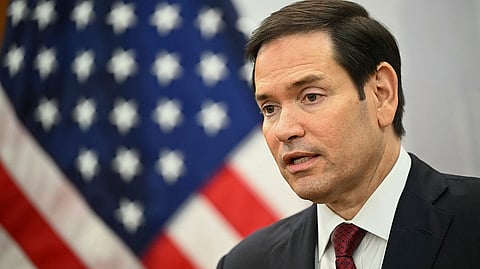
Marco Rubio says India-US trade deal is close, links talks to Russia sanctions waiver
US Secretary of State Marco Rubio on Monday said Washington was “very close” to finalising a trade agreement with India, adding that the ongoing negotiations were among the factors considered by President Donald Trump when deciding on national security waivers related to Russian energy.
His remarks come days after Trump waived certain sanctions and tariff measures targeting buyers of Russian energy, including India and four other countries, citing national security considerations.
“We're trying to finalise a trade deal with India right now. We're very close to doing that. So that's one of the things we take into consideration when the President makes a decision about national security waivers and things of that nature,” Rubio told reporters in Samarkand, Uzbekistan.
Rubio is scheduled to visit India on Tuesday and meet External Affairs Minister S Jaishankar in Mumbai. Trade, energy, investment, defence and critical technologies are expected to feature in the discussions.
Rubio explains US decision to waive Russia-related sanctions
Explaining Washington’s approach to Russian energy purchases, Rubio said the US had been compelled to waive some sanctions in recent months because of their potential impact on global supplies and prices.
“We've had to waive sanctions over the past few months” because of the global supply situation and “the impact it was having on other countries”, he said.
Trump had waived several sanctions related to Russian energy that were due to take effect under the Lindsey O. Graham Sanctioning Russia and Iran Act, citing national security reasons. The proposed measures could have imposed tariffs of up to 100% on the five largest purchasers of Russian crude oil or gas, including India.
The sanctions measures have been put on hold rather than permanently scrapped, leaving the US President with the option of invoking them against the countries concerned at a later stage.
When asked whether Washington was now comfortable with countries continuing to buy Russian energy, Rubio pointed to the pressure of high fuel prices across the world.
“I know diesel prices are high in the United States, but they're really, really high in a bunch of other countries around the world,” he said.
He also highlighted the geographical challenges some countries face when trying to diversify their energy imports.
“Geography is real. For some countries, it's very difficult to acquire energy from alternative sources. That's not an excuse, but all of that has to be balanced when you make foreign policy,” Rubio said.
India cannot shift away from Russian energy overnight, Rubio says
Rubio's latest comments follow his acknowledgement a day earlier that India had diversified its energy sources but could not immediately move away from Russian supplies.
He had said India was still obtaining a substantial amount of energy from Russia because it was difficult to change suppliers overnight.
“It's still getting a substantial amount of energy from Russia because it's hard to pivot from one day to the next,” Rubio said.
His remarks indicate that Washington's decisions on energy-related sanctions are being weighed against several considerations, including global fuel availability, the economic impact on other countries and the broader relationship with India.
The trade negotiations have also featured in this calculation, with Rubio explicitly identifying the near-finalisation of the agreement as one factor considered when the US President makes decisions on national security waivers.
Piyush Goyal says first tranche of trade deal is ready
Commerce and Industry Minister Piyush Goyal said last week that the first tranche of the India-US bilateral trade agreement had been finalised and was undergoing legal drafting.
“The US bilateral trade agreement's first tranche has been finalised. It's going through the final contours, the legal drafting, and we hope to be able to finalise that soon and operationalise it once we get a comparable or competitive advantage over our peer countries,” Goyal said.
The first tranche is therefore at the legal-drafting stage, although its finalisation and implementation remain subject to the completion of the necessary processes and India's assessment of the terms.
US Ambassador to India Sergio Gor has also recently described the negotiations as moving at an “incredible pace”, saying major components of the agreement had been finalised.
The two countries are seeking to resolve the remaining issues and advance the trade pact as they work to strengthen their economic relationship.
Rubio's India visit to focus on bilateral ties
Rubio's visit to India comes at a time when both countries are working to advance trade negotiations while managing differences over energy imports and sanctions on Russia.
His meeting with Jaishankar in Mumbai on Tuesday is expected to cover ways to deepen the India-US strategic partnership, including trade and investment, energy cooperation, defence and critical and emerging technologies.
The discussions will take place against the backdrop of Washington's efforts to restrict Russia's energy revenues and India's continuing need to secure affordable energy supplies.
Rubio's statement that the trade deal is close to completion signals progress in the negotiations, but no final signing date or complete terms of the agreement have been announced.


