.png)
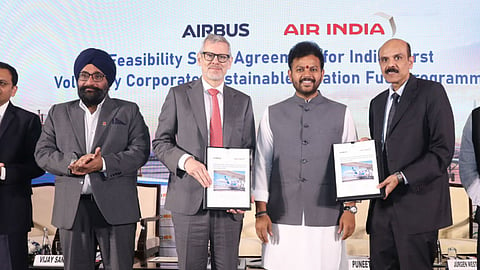
Air India, Airbus sign pact to develop India's first corporate green aviation fuel programme
Air India and European aircraft manufacturer Airbus on Tuesday signed an agreement to explore the development of India's first voluntary corporate Sustainable Aviation Fuel (SAF) programme, aimed at helping businesses reduce emissions associated with air travel and supporting the aviation industry's transition towards cleaner energy.
The feasibility study agreement was signed by Jürgen Westermeier, President and Managing Director of Airbus India and South Asia, and P Balaji, Group Head of Governance, Risk, Compliance and Corporate Affairs at Air India, in the presence of Civil Aviation Minister Rammohan Naidu Kinjarapu.
The proposed initiative would enable companies to voluntarily support the procurement and use of SAF on selected Air India routes, while allowing eligible corporate customers to account for associated reductions in their business travel emissions.
The programme, if implemented, would become India's first voluntary corporate SAF initiative, providing a framework for wider private-sector participation in aviation decarbonisation.
𝐂𝐨𝐫𝐩𝐨𝐫𝐚𝐭𝐞 𝐒𝐀𝐅 𝐟𝐫𝐚𝐦𝐞𝐰𝐨𝐫𝐤
Under the proposed arrangement, Air India would procure and use sustainable aviation fuel and sell or transfer the associated Scope 3 SAF certificates to eligible corporate customers.
These certificates would enable participating businesses to account for verified emissions reductions associated with SAF use, without requiring them to purchase or blend the fuel directly.
The emissions savings would be calculated by comparing the lifecycle carbon footprint of SAF with conventional aviation turbine fuel, using internationally recognised standards.
The mechanism is intended to help companies monitor and report progress towards their sustainability commitments while encouraging greater demand for alternative aviation fuels.
The feasibility study will also examine how the programme could be expanded across different industries and contribute to developing a domestic SAF ecosystem.
𝐀𝐢𝐫 𝐈𝐧𝐝𝐢𝐚 𝐬𝐞𝐞𝐤𝐬 𝐜𝐥𝐞𝐚𝐧𝐞𝐫 𝐟𝐥𝐢𝐠𝐡𝐭𝐬
Air India Chief Executive Officer and Managing Director Tewolde Gebremariam said achieving the aviation industry's decarbonisation objectives would require coordinated efforts from airlines, manufacturers, businesses and other stakeholders.
He said the collaboration would explore a mechanism through which companies could support SAF adoption and reduce emissions associated with corporate travel.
The airline also emphasised that increasing demand for sustainable aviation fuel would be essential to expanding production capacity and establishing a commercially viable supply chain in India.
Westermeier said SAF offered significant potential to reduce aviation emissions and that Airbus was working with regulators, airlines, airports, fuel producers and research institutions to accelerate its adoption.
He described the partnership with Air India as an important step towards encouraging wider industry participation in the region's transition to cleaner aviation.
Balaji said developing a viable SAF ecosystem would require sustained demand, collaboration and participation from businesses across sectors.
𝐈𝐧𝐝𝐢𝐚'𝐬 𝐒𝐀𝐅 𝐚𝐦𝐛𝐢𝐭𝐢𝐨𝐧𝐬
The partnership comes as India works towards establishing a policy framework for sustainable aviation fuel in its rapidly expanding civil aviation sector.
The government has proposed introducing a 1 per cent SAF blending requirement in aviation turbine fuel from 2027, with the proportion expected to increase to 5 per cent by 2030.
India is estimated to have the potential to produce approximately 10 million tonnes of SAF annually by 2040, although achieving this capacity could require investments of $70 billion to $85 billion.
Sustainable aviation fuel, produced from eligible renewable or waste-derived feedstocks, can reduce lifecycle greenhouse gas emissions compared with conventional jet fuel, depending on the production pathway and feedstock used.
However, limited production capacity, high costs and inadequate supply infrastructure remain major challenges to widespread adoption.
The proposed corporate programme seeks to address part of this challenge by encouraging businesses to contribute financially towards SAF procurement and helping generate demand for domestic production.
𝐅𝐥𝐞𝐞𝐭 𝐦𝐨𝐝𝐞𝐫𝐧𝐢𝐬𝐚𝐭𝐢𝐨𝐧 𝐮𝐧𝐝𝐞𝐫𝐰𝐚𝐲
The initiative forms part of Air India and Airbus' broader strategy to reduce aviation's environmental footprint through newer aircraft, operational improvements and alternative fuels.
Air India has approximately 600 new aircraft on order, including 350 from Airbus, as part of its fleet renewal programme.
The airline expects the induction of more fuel-efficient aircraft to reduce emissions while enabling additional non-stop connections between cities, potentially lowering fuel consumption associated with connecting flights.
Air India has also introduced flight-planning and route-optimisation systems, along with operational measures such as single-engine taxiing, autonomous electric-vehicle towing and more frequent engine and airframe cleaning.
Other initiatives include reducing single-use plastics and introducing lighter cabin materials to lower aircraft weight and fuel consumption.
𝐍𝐞𝐭-𝐳𝐞𝐫𝐨 𝐭𝐚𝐫𝐠𝐞𝐭 𝐛𝐲 𝟐𝟎𝟓𝟎
The proposed programme aligns with the aviation industry's ambition to achieve net-zero carbon emissions by 2050, supported by organisations including the International Air Transport Association, International Civil Aviation Organization and Air Transport Action Group.
The feasibility study will assess how participating companies can track emissions reductions through credible reporting mechanisms while supporting the wider adoption of sustainable fuels.
Although the agreement does not constitute the immediate launch of a commercial SAF programme, it establishes the basis for developing a voluntary model that could bring more businesses into India's aviation decarbonisation efforts.
The two companies aim to use the study to create a scalable framework capable of supporting domestic SAF demand and contributing to the aviation sector's long-term emissions reduction goals.


